Using Psychological Measures to Understand How A Person’s Personality Affects Their Choice in Sports and Performance
The knowledge of personality is critical to success as a coach, teacher, health care professional, or exercise leader. You may be tempted to use psychological tests to gather information about the people whom you want to help professionally. Bear in mind, however, that psychological inventories alone cannot predict athletic success and they have sometimes been used unethically—or at least inappropriately—and administered poorly. It is essential that professionals understand the limitations and the uses and abuses of testing to know what to do and what not to do. A better approach to using personality measures is to identify athletes who might need greater support, to identify athletes and exercisers who might be more susceptible to disputes and clashes, and to help oneself as a physical activity leader or coach understand one’s own personality. You want to be able to make an informed decision—that is, to be an informed consumer—on how (or whether) to use personality tests. Read on….. this is all an important aspect of Sports Psychology Coaching.
The following are important questions in consider about psychological testing:
- Should psychological tests be used to help select athletes for a team?
- What qualifies someone to administer psychological tests?
- Should coaches give psychological tests to their athletes?
- What types of psychological tests should be used with athletes?
- How should psychological tests be administered to athletes? In 1999, the American Psychological Association and the National Council on Measurement in Education provided seven helpful guidelines on the use of psychological tests. We explain these guidelines briefly in the following sections.
Know the Principles of Testing and Measurement Error
Before you administer and interpret psychological inventories you should understand testing principles, be able to recognize measurement errors, and have well-designed and validated measures. Not all psychological tests have been systematically developed and made reliable. Making predictions or drawing inferences about an athlete’s or exerciser’s behavior and personality structure since these tests would be misleading and unethical. Test results are not absolute or irrefutable. Even valid tests that have been reliably developed may have measurement errors.
Suppose you wish to measure self-esteem in 10- to 12-year-old physical education students. You choose a good test developed for adults because no tests have been developed specifically for youngsters. If the students do not fully understand the questions, however, the results will not be reliable. Similarly, if you give a test developed on a predominantly white population to African American and Hispanic athletes, the results might be less reliable because of cultural differences. In these situations, a researcher should conduct pilot testing with the specific population to establish the reliability and validity of the test instrument. People usually want to present themselves in a favorable light. Sometimes they answer questions in what they think is a socially desirable way, a response style known as “faking good.” For example, an athlete may fear letting her coach know how nervous she gets before competition, so she skews her answers on a precompetitive anxiety test to appear calm, cool, and collected.
Know Your Limitations
The American Psychological Association recommends that people administering tests be aware of the limitations of their training and preparation. However, some people do not recognize the limits of their knowledge, or they use and interpret test results unethically, which can be damaging to the athletes. For instance, it is inappropriate to use personality inventories developed to measure psychopathology (abnormality, such as schizophrenia or manic depression) to measure a more normal increase in anxiety. Furthermore, it is inappropriate to give physical education students a clinical personality test.
Do Not Use Psychological Tests for Team Selection
Using only psychological tests to select players for a team is an abuse because the tests are not accurate enough to be predictive. For example, determining whether an athlete has the “right” psychological profile to be a middle linebacker in football or a point guard in basketball based on psychological tests alone is unfair. Some psychological tests may have limited use, but they must be considered in conjunction with physical performance measures, coach evaluations, and the actual levels of play. Using personality inventories alone to select athletes for a team or to cut them from a team is an abuse of testing that should not be tolerated. When psychological tests are used as part of a battery of measures to help in the athlete-selection process, three key conditions should always be kept in mind:
- The test must be a valid and reliable measure.
- The user must know what personality characteristics are key for success in the sport of interest and the ideal levels of those characteristics needed.
- The user should know how much athletes can compensate in some characteristics for the lack of others.
Include Explanation and Feedback
Before they complete tests, athletes, students, and exercisers should be told the purpose of the tests, what they measure, and how the tests are going to be used. Athletes should receive specific feedback about the results to allow them to gain insight into themselves from the testing process.
Assure Athletes of Confidentiality
It is essential to assure people that their answers will remain confidential in whatever tests they take (and to ensure that this confidentiality is maintained!). With this assurance, test takers are more likely to answer truthfully. When they fear exposure, they may fake or falsify their answers, which can distort the findings and make interpretation virtually useless. Students in a physical education class might wonder if a test will affect their grades, and in these circumstances, they are more likely to exaggerate their strengths and minimize their weaknesses. If you do not explain the reasons for testing, test takers typically become suspicious and wonder whether the coach will use the test to help select starters or weed out players.
Take an Intraindividual Approach
It is often a mistake to compare an athlete’s psychological test results with the norms, even though in some cases such a comparison might be useful. Athletes or exercisers might seem to score high or low in anxiety, self-confidence, or motivation in relation to other people, but the more critical point is how they are feeling relative to how they usually feel (an intraindividual approach). Use this psychological information to help them perform better and enjoy the experience more, but relative to their own standards, not the scores of others.
Take the example of assessing an exerciser’s motivation. It isn’t as important to know whether the individual’s motivation to exercise is high or low compared to that of other exercisers as much as how it compares with competing motivations that exerciser has (e.g., being with his family or carrying out his job responsibilities).
Understand and Assess Specific Personality Components in Sports
A clear understanding of the components of personality provides you with some perspective for using and interpreting psychological tests. For example, to measure someone’s personality, you would certainly be interested in her psychological core. You would select specific types of tests to gain an accurate understanding of the various aspects of her personality. To measure more subconscious and deeper aspects of personality, you could use a projective test, for example.
Projective tests usually include pictures or written situations, and the test takers are asked to project their feelings and thoughts about these materials. Hence, someone might be shown a photo of an exhausted runner crossing a finish line at the end of a highly contested cross-country race and then be asked to write about what is happening. A high-achieving, confident person might emphasize how the runner made an all-out effort to achieve her goal, whereas a low achiever might project feelings of sorrow for losing the race in a close finish. Projective tests are interesting, but they are often difficult to score and interpret. Consequently, sport psychologists usually assess personality in sport by looking at typical responses invoked by the actual situation they are interested in.
For instance, coaches want to know more than whether an athlete is generally anxious—they also want to know how the athlete deals with competitive anxiety. So, a test that measures anxiety in sport would be more useful to a coach or sport psychologist than would a test that measures anxiety in general. Likewise, a test that measures motivation for exercise would be more useful to an exercise leader than a general motivation test would be.
Focusing on Personality Research
The research from the 1960s and 1970s yielded few useful conclusions about the relationship of personality to sport performance. In part these meager results stemmed from methodological, statistical, and interpretive problems, which we discuss later. Researchers were divided into two camps; one group took a credulous viewpoint; that is, these researchers believed that personality is closely related to athletic success. The other group had a skeptical viewpoint and argued that personality is not related to athletic success. Neither the credulous nor the skeptical viewpoint appears to have proved correct. Rather, some relationship exists between personality and sport performance and exercise involvement, but it is far from perfect. That is, although personality traits and states can help predict sport behavior and success, they account for only some of the behavior and may not be as precise as hoped.
For example, the fact that some Olympic long-distance runners exhibit introverted personalities does not mean that a long-distance runner needs to be introverted to be successful. Similarly, although many successful middle linebackers in football have aggressive personalities, other successful middle linebackers do not. We now turn our focus to the research on personality, sport performance, and sport preference. But remember that personality alone doesn’t account for behavior in sport and exercise. Some caution is needed in interpreting the findings of personality research because an attribution or assumption of cause-and-effect relationships between personality and performance was a problem in many of the early studies.
Athletes and Non-Athletes
Try to define an athlete. It isn’t easy. Is an athlete someone who plays on a varsity or interscholastic team? Is it someone who demonstrates a certain level of skill? Who jogs daily to lose weight? Who plays professional sports? Who plays intramural sports? Keep this ambiguity in mind as you read about studies that have compared personality traits of athletes and nonathletes. Such ambiguity in definitions has weakened this research and clouded its interpretation.
For years it was thought that few consistent differences existed between athletes and nonathletes on personality measures. However, recent reviews of literature have concluded that because of better measures and conceptual approaches used by researchers, consistent differences do emerge with athletes being more extroverted and conscientious and less neurotic than non-athletes. However, these differences tend to be very small. It’s also possible that certain personality types are drawn to sport, rather than participation in a sport somehow changing one’s personality.
Female Athletes
As more women compete in sport, we need to understand the personality profiles of female athletes. In 1980, Williams found that successful female athletes differed markedly from the normative female in terms of personality profile. Compared with female non-athletes, female athletes were more achievement oriented, independent, aggressive, emotionally stable, and assertive. Most of these traits are desirable for sport. Apparently, outstanding athletes have similar personality characteristics regardless of whether they are male or female.
Positive Mental Health and the Iceberg Profile
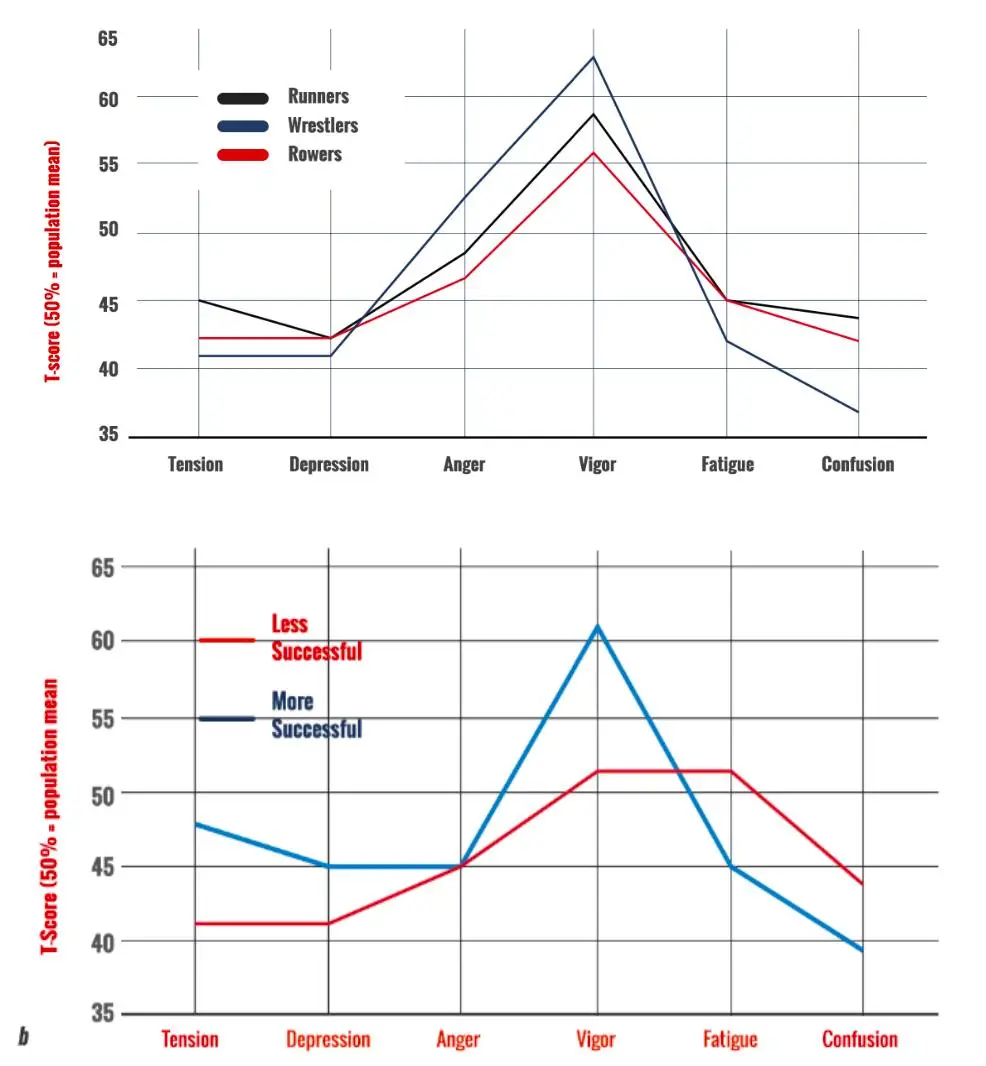
After comparing personality traits of more successful athletes with those of less successful athletes using a measure called the Profile of Mood States (POMS), Morgan developed a mental health model that he reported to be effective in predicting athletic success. Basically, the model suggests that positive mental health as assessed by a certain pattern of POMS scores is directly related to athletic success and high levels of performance.
Morgan’s model predicts that an athlete who scores above the norm on the POMS subscales of neuroticism, depression, fatigue, confusion, and anger and below the norm on vigor will tend to pale in comparison with an athlete who scores below the norm on all these traits except vigor, instead scoring above the norm on vigor. Successful elite athletes in a variety of sports (e.g., swimmers, wrestlers, oarsmen, and runners) are characterized by what Morgan called the iceberg profile, which reflects positive mental health. The iceberg profile of a successful elite athlete shows vigor above the mean of the population and tension, depression, anger, fatigue, and confusion below the mean of the population. The profile looks like an iceberg in that all negative traits are below the surface (population norms) and the one positive trait (vigor) is above the surface. In contrast, less successful elite athletes have a flat profile, scoring at or below the 50th percentile on nearly all psychological factors. According to Morgan, this reflects negative mental health.
Performance Predictions Based on Personality of Athletes and Exercisers
Morgan (1979) psychologically evaluated 16 candidates for the 1974 U.S. heavyweight rowing team using the POMS, correctly predicting 10 of the 16 finalists. Success with this and similar studies led Morgan to conclude that more successful athletes exhibit the iceberg profile and more positive mental health than those who are less successful. You might think that these impressive statistics mean you should use psychological tests for selecting athletes for a team. However, as you will later read, most sport psychologists vehemently oppose using psychological tests for team selection and, in fact, Morgan did not think the test should be used for selection purposes. Personality testing is far from perfect (only 10 of 16 rowers were correctly predicted), and use of testing for selection might mean that athletes will be unfairly and erroneously selected for or cut from a team.
Although the iceberg profile model is still supported in the literature, it has received criticism. Some believe that the evidence was insufficient to conclude that the profile differentiates athletes of varying levels of ability; instead, it distinguished only athletes from nonathletes. Other colleagues conducted a statistical review (called a meta-analysis ) of all the iceberg profile research and found that the profile did indeed differentiate successful from less successful athletes but accounted for a very small percentage (less than 1%) of their performance variation. The evidence does not justify using the instrument as a basis for team selection and that users must be careful to protect against social desirability effects (e.g., participants “faking good” to impress their coaches). The POMS is not a test for “identifying champions,” as Morgan had originally proposed in his iceberg profile model of mental health. At the same time, this does not imply that the test is useless. Optimal mood profiles are most likely sport dependent; therefore, mood changes in athletes should be compared with the athletes’ previous mood levels and not with large-group norms.
Drawing on research and experience in consulting with athletes, the POMS test can be appropriate for use in the following ways:
- To monitor the athlete ’s mind-set
- To catalyze discussion during one-on-one sessions
- To improve one’s mood over time
- To identify problems early
- To monitor the mood of team officials and support staff
- To monitor training load
- To monitor an athlete during the acclimatization process
- To identify overtrained athletes
- To monitor an athlete during rehabilitation from overtraining
- To monitor emotional responses to injury
- To predict performance (but not for athlete selection)
- To individualize mental training
Thus, iceberg profile research clearly has implications for professional practice. However, the criticisms of this research have shown that it is not possible to realistically select teams or accurately predict major variations in athletic performance on the simple basis of giving a personality measure. Personality data of this type, however, have useful purposes. Such data can help sport psychologists discover the kinds of psychological traits and states associated with successful athletes, and once these psychological factors are understood, athletes can work with sport psychologists and coaches to develop psychological skills for improving performance. For example, psychological skills training can help exercisers and athletes cope more effectively with anger and anxiety. This is helpful to personal trainers.
In summary, personality tests are useful tools that help us better understand, monitor, and work with athletes and exercisers. They are not magical instruments that allow us to make sweeping generalizations about individuals’ behaviors and performances.
Exercise and Personality
Sport psychologists have investigated the relationship between exercise and personality. We will begin by briefly summarizing the research on the relationship between the Big 5 personality traits and physical activity involvement. The relationship between exercise and two personality dispositions, type A behavior and self- concept, will then be briefly reviewed.
Big 5 Personality Correlates of Physical Activity
The relationship between physical activity involvement and the Big 5 personality traits of neuroticism, extraversion, openness to experience, agreeableness, and conscientiousness has been examined in a variety of studies. A meta-analysis of 33 of these studies revealed that extraversion and conscientiousness are positively related to physical activity involvement, while neuroticism is negatively related (Rhodes & Smith, 2006). This makes sense as people who are more sociable or outgoing and more self-disciplined and achievement oriented are more likely to exercise, while those who are depressed and anxious are not.
However, similar to the relationship between personality measures and athletic involvement, these associations are relatively small and mostly correlational. Few cause–effect relationships have been established. This has lead reviewers to conclude that “behavioral action is unlikely to arise directly from personality” and the greatest contribution will come from looking at how other personality constructs interact with environment considerations to produce behavior.
Grit
In her best-selling book Grit: The Power of Passion and Perseverance, psychologist Angela Duckworth (2016) introduced the notion of grit, an important personality characteristic related to the pursuit of goals in many fields. Grit is defined as “. . . trait-level perseverance and passion for long-term goals”. It involves maintaining interest and effort while strenuously working toward goals and challenges despite facing adversity, failure, and slow progress. Gritty individuals exhibit stamina when working toward achievement and maintain their effort over years.
A valid and reliable measure of grit has been developed, and in addition to an overall scale score, two subscales are assessed: consistency of one’s interest and perseverance of effort. Duckworth and her colleagues studied a variety of populations in a variety of settings and found that within those settings, grittier individuals are less likely to drop out of the U.S. Military Academy at West Point, and more likely to stay married, spend time practicing spelling, and further their education.
While Duckworth discusses the importance of grit to sport success, only a few studies have begun to explore this relationship. In a study examining the predictive validity of grit in predicting West Point cadet attrition and performance, grit was found to predict physical and athletic performance. In a study of high- versus low-grit elite youth soccer players, found that gritty players engaged in significantly more training, competition, play, and indirect soccer involvement. The grittier players were also found to perform better than their less gritty counterparts on perceptual-cognitive skills tests. Although additional studies are needed, initial evidence points to the importance of grit in predicting athlete and exerciser performance and motivation.
Type A Behavior
The type A behavior pattern is characterized by a strong sense of urgency, an excess of competitive drive, and an easily aroused hostility. The antithesis of the type A behavior pattern is called type B. Initially, a link was found between type A behavior and increased incidence of cardiovascular disease. Later, it was suspected that the anger–hostility component of the type A construct is the most significant disease-related characteristic. Although the causes of type A behavior have not been conclusively determined, considerable evidence points to the sociocultural environment, such as parental expectations of high standards in performance, as the likely origin.
Early efforts to modify type A behavior through exercise interventions have had mixed results. One positive study showed that a 12-week aerobics program not only was associated with reductions in type A behavior but also helped participants significantly reduce cardiovascular reactivity to mental stress. Thus, changing type A behavior patterns through exercise could result in positive health benefits.
Self-Concept
Exercise appears to also have a positive relationship with self-concept suggested that these changes in self-concept might be associated with the perception of improved fitness rather than with actual changes in physical fitness. Although studies so far have not proved that changes in physical fitness produce changes in self-concept, exercise programs seem to lead to significant increases in self-esteem, especially with subjects who initially show low self-esteem. Girls participating in the Girls on the Run program had positive changes in their global self-esteem and in appearance, peer, physical, and running self-concepts.
Parallel to the sport personality research, the exercise and self-concept research has shown that it is best to think of self-concept or self-esteem not only as a general trait (global self-esteem) but also as one that includes numerous content-specific dimensions, such as social self-concept, academic self-concept, and physical self- concept. As you might expect, research shows that exercise participation has the greatest effect on the physical dimension of self-concept.
Examining Cognitive Strategies and Success
Although some differences are evident among the personality traits and dispositions of athletes and exercisers, researchers have not been satisfied with the utility of the information thus far. For this reason, many contemporary investigators have adopted the phenomenological approach to studying personality and turned from studying traditional traits to examining mental strategies, skills, and behaviors that athletes use for competition and their relationship to performance success.
One of the first studies to take this approach was an investigation of gymnasts competing for berths on the U.S. men’s gymnastics team. The authors found that the gymnasts who made the team coped better with anxiety, used more internal imagery, and used more positive self-talk than those who didn’t make the team.
Resulting from theories developed after many studies, researchers have created and validated a measure of sport-specific psychological skills, the Athletic Coping Skills Inventory (ACSI). The ACSI yields an overall score of an athlete’s psychological skills as well as scores on the following seven subscales:
- Coping with adversity
- Peaking under pressure
- Goal setting and mental preparation
- Concentration
- Freedom from worry
- Confidence and achievement motivation
- Coachability
Smith and colleagues examined the relationship between the overall scale and subscale scores and athletic performance in two studies. In the first study, 762 high school male and female athletes representing a variety of sports completed the ACSI. They were classified as underachievers (those who had a coach’s talent rating that was higher than their actual performance ratings), normal achievers (those whose ratings were equal to their actual performance), and overachievers (those who were rated by their coaches as performing above their talent level). The study showed that, compared with the other groups, the overachieving athletes had significantly higher scores on several subscales (coachability, concentration, coping with adversity) as well as higher total scale scores. These results show that psychological skills can assist athletes in getting the most out of their physical talent.
The sample in the second study was a quite different group of athletes: 104 minor league professional baseball players. Scores on the ACSI were related to such performance measures as batting averages for hitters and earned run averages for pitchers. Interestingly, as with the high school athletes from the first study, expert ratings of physical skills did not relate to ACSI scores. Moreover, psychological skills accounted for a significant portion of performance variations in batting and pitching, and these skills contributed even more than physical ability. (Remember that these were all highly skilled and talented athletes, so this does not mean that physical talent is unimportant.) Finally, higher psychological skill scores were associated with player survival or continued involvement in professional baseball 2 and 3 years later. Thus, performance in elite sport appeared to be clearly related to mental skills.
A third study using the ACSI was conducted with Greek athletes (basketball, polo, and volleyball) at both the elite and nonelite levels. It revealed several differences, most notably that the elite athletes all showed superior ability, compared with the nonelite controls, to cope with adversity. The elite athletes were also better at goal setting and mental preparation.
Although the ACSI is a useful measurement tool for research and educational purposes, we are warned that it should not be used for team selection. They argued that if athletes think the ACSI is being used for selection purposes, they are likely to knowingly give answers that will make themselves look good to coaches or to unwittingly give certain responses in hopes that they will become true.
The association between cognitive strategies and performance is supported by additional studies. Reviews of the literature have shown that cognitive strategies improve soccer performance (Slimani et al., 2016) and performance on strength, endurance, and muscular power tasks.
In-Depth Interview Techniques
Researchers have also attempted to investigate the differences between successful and less successful athletes by taking a qualitative approach (a growing methodological trend in the field, as mentioned in chapter 2). In-depth interviews probe the coping strategies that athletes use before and during competition. The interview approach provides coaches, athletes, and sport psychologists with much more in-depth personality profiles of an athlete than do paper-and-pencil tests. For example, all 20 members of the 1988 U.S. Olympic freestyle and Greco-Roman wrestling teams were interviewed. Compared with nonmedalist wrestlers, Olympic medal winners used more positive self-talk, had a narrower and more immediate focus of attention, were better prepared mentally for unforeseen negative circumstances, and had more extensive mental practice (Gould, Eklund, & Jackson, 1993).
One wrestler described his ability to react automatically to adversity:
“Something I’ve always practiced is to never let anything interfere with what I’m trying to accomplish at a particular tournament. So, what I try to do is if something is [maybe going] to bother me . . . completely empty my mind and concentrate on the event coming up . . . . My coping strategy is just to completely eliminate it from my mind, and I guess I’m blessed to be able to do that”.
Medalists seemed able to maintain a relatively stable and positive emotional level because their coping strategies became automatic, whereas non-medalists had more fluctuating emotions as a consequence of not coping well mentally. Take the following example of a non-medalist Olympic wrestler:
“I had a relaxation tape that seemed to give me moments of relief . . . . It got to the point where what you would try to do was not think about wrestling and get your mind on other things. But inevitably . . . you would bind up and get tight, [your] pulse would pick up, and your palms and legs and hands or feet [would be] sweating. You go through that trying to sleep, and I would resort to my relaxation tape. I don’t think I coped very well with it really”.
Mental Plans
Mental planning is a large part of cognitive strategies. Additional quotes from Olympic athletes may help further explain the benefits and workings of the mental strategies mentioned by the wrestlers just quoted:
“The plan or program was already in my head. For the race I was on automatic, like turning the program on cruise control and letting it run. I was aware of the effort I was putting in and of my opponent’s position in relation to me, but I always focused on what I had to do next.”
“Before I start, I focus on relaxing, on breathing calmly. I feel activated but in control since I’d been thinking about what I was going to do in the race all through the warm-up. I used the period just before the start to clear my mind, so when I did start the race all my thoughts about what I would be doing in the race could be uncluttered”.
“I usually try to work with my visualization on what it is I’m likely going to use. Different wrestlers have different moves, you know. They always like to throw a right arm spin or something, and I’ll visualize myself blocking that and things like that.”
Olympic athletes learn a systematic series of mental strategies to use before and during competition, including refocusing plans. Thus, they come prepared mentally not only to perform but also to handle distractions and unforeseen events before and during the competition (Gould & Maynard, 2009; Orlick & Partington, 1988). These mental plans especially help athletes whose sense of control (a personality trait) is low; the plans allow them to feel more in control regardless of situational influences.
This swimmer’s refocusing plan to meet the demands of the situation shows how important it is to study both an athlete’s personality profile and his or her cognitive strategies and plans. In this way, coaches can continually structure practices and training environments to meet the situation and maximize performance and personal growth.
Identifying Your Role in Understanding Personality
Now that you have learned something about the study of personality in sport and exercise settings, how can you use the information to better understand the individuals in your classes and on your teams? Later chapters explore the practical aspects of changing behaviors and developing psychological skills. In the meantime, use these guidelines to help you better understand the people with whom you work now and to consolidate what you have learned about personality structure.
- Consider both personality traits and situations. To understand someone’s behavior, consider both the person and the situation. Along with understanding personality, always take into account the particular situation in which you are teaching or coaching.
- Be an informed consumer. To know how and when to use personality tests, understand the ethics and guidelines for personality testing. This chapter has provided guidelines. As a professional, it will be your responsibility to understand the dos and don’ts of personality testing.
- Be a good communicator. Although formal personality testing can disclose a great deal about people, so can sincere and open communication. Asking questions and being a good listener can go a long way toward establishing rapport and finding out about an individual’s personality and preferences.
- Be a good observer. Another good way to gain valuable information about people’s personalities is to observe their behavior in different situations. If you combine your observation of an individual’s behavior with open communication, you’ll likely get a well- rounded view and understanding of his or her personality. 5. Be knowledgeable about mental strategies. A constellation of mental strategies facilitates the learning and performance of physical skills. Be aware of these strategies and implement them appropriately in your programs, selecting them to benefit an individual’s personality.

Summary
- Describe what makes up personality and why it is important. Personality refers to the characteristics or blend of characteristics that makes individuals unique. It comprises three separate but related levels: a psychological core, the most basic and stable level of personality; typical responses, or the ways each person learns to adjust to the environment; and role-related behaviors, or how a person acts based on what she perceives the situation to be. Role-related behavior is the most changeable aspect of personality. Understanding personality will help you improve your teaching and coaching effectiveness.
- Discuss major approaches to understanding personality. Six major routes to studying personality in sport and exercise are the psychodynamic, trait, situation, interactional, phenomenological, and integrative, or biopsychosocial, approaches. The psychodynamic approach emphasizes the importance of unconscious determinants of behavior and of understanding the person as a whole. It has had little impact in sport psychology. The trait approach assumes that personality is enduring and consistent across situations and that psychological traits predispose individuals to behave in consistent ways regardless of the situation. In contrast, the situational approach argues that behavior is determined largely by the environment or situation. Neither the trait nor the situational approach has received widespread support in the sport psychology literature. Most researchers take an interactional approach to the study of sport personality, which considers personal and situational factors as equal determinants of behavior. The phenomenological approach focuses on a person’s understanding and subjective interpretation of himself and his environment versus fixed traits. This highly held view is also consistent with the interactional view in that behavior is believed to be determined by personal and situational factors. The integrative, or biopsychosocial, approach contends that to understand personality, one needs to consider the dynamic interaction of biological factors, dispositional traits, adaptions one makes to situations, and self-defined life stories or narratives that are all situated in one’s social context or culture.
- Identify how personality can be measured. To measure personality, an interactional approach should assess both psychological traits (an individual’s typical style of behaving) and states (the situation’s effects on behaviors). Although general personality scales provide some useful information about personality states and traits, situation-specific measures (e.g., sport-specific measures) predict behavior more reliably.
- Assess personality tests and research for practicality and validity. Although useful, psychological tests alone have not proved to be accurate predictors of athletic success. And when they are used, they must be used ethically. Users of personality tests must know the principles of testing and measurement error, know their own limitations relative to test administration and interpretation, avoid using tests alone for team selection, always give athletes test explanations and feedback, assure athletes of confidentiality, take an intraindividual approach to testing, and understand and assess specific personality components.
- Understand the relationship between personality and behavior in sport and exercise. Exercise has been found to enhance self-concept, especially the physical component of one’s self. Type A behavior has been shown to be an important personality factor influencing wellness. Although some personality differences have been found through comparison of athletes with nonathletes and comparison of athletes from different sports, the most interesting and consistent findings come from comparisons of less successful athletes with more successful athletes exhibiting more positive mental health. These results, however, have limited application.
- Describe how cognitive strategies relate to athletic success. Over the last several decades, researchers have turned their attention away from measuring traditional traits and toward examining the cognitive or mental strategies, skills, and behaviors that athletes use. Successful athletes, compared with their less successful counterparts, possess a variety of psychological skills. These include arousal regulation and management, high self-confidence, better concentration and focus, feelings of being in control and not forcing things, positive imagery and thoughts, commitment and determination, goal setting, well- developed mental plans, and well-developed coping strategies.
- Apply what you know of personality in sport and exercise settings to better understand people’s personalities. As a professional in sport and exercise, you need to gather information about the personalities of people with whom you work. Specifically, consider both personality traits and situations, be an informed consumer, communicate with athletes, observe your subjects, and be knowledgeable about mental strategies.
REVIEW AND UNDERSTAND
- Discuss the three levels of personality, including the stability of the different levels.
- Compare and contrast the psychodynamic, situation, trait, interactional, phenomenological, biopsychosocial, and integrative approaches to personality. Which approaches are most common among sport psychologists today? Why?
- Compare and contrast state and trait measures of personality. Why are both needed for a better understanding of personality in sport?
- Why are sport-specific personality inventories more desirable than general psychological inventories for measuring personality in sport and exercise? Name examples of both sport-specific and general personality measures.
- Discuss four import ant guidelines for administering psychological tests and providing feedback from the results of these tests.
- Discuss the research comparing the personalities of athletes and nonathletes and male and female athletes. Do athletes versus nonathletes and male versus female athletes have unique personality profiles?
- Discuss Morgan ’s mental health model and the iceberg profile as they relate to predicting athletic success. Can athletic success be predicted from psychological tests? Explain.
- What personality factors are related to exercise behavior?
If you enjoy this topic, you will want to explore the Sports Psychology Coach Certification.