The Structure and Physiology of the Human Brain
As coaches working with clients, we are often guiding a program to meet goals related to health and well-being. Based on this need, we will dive into some basic principles about the anatomy and physiology of the brain. To begin understanding the human brain, we are going to turn our focus to its neurotransmitters and their impact on brain function.
The Cerebral Cortex
The lobes of the cerebral cortex serve many different functions within the brain. With the total volume of the brain being approximately 1500 cubic centimeters, the size of the cerebral cortex is an impressive 75% percent of this volume. The surface of the cerebral hemispheres contains a layer of gray matter on the outside of the brain, composed of gyri and sulci. Together, they create a cortical thickness of 2.2 meters in the cerebral cortex that is involved in regulating sensation, voluntary movement, self-awareness, and communication. The cerebral cortex is divided into four primary lobes:
- frontal lobe
- temporal lobe
- parietal lobe
- occipital lobe
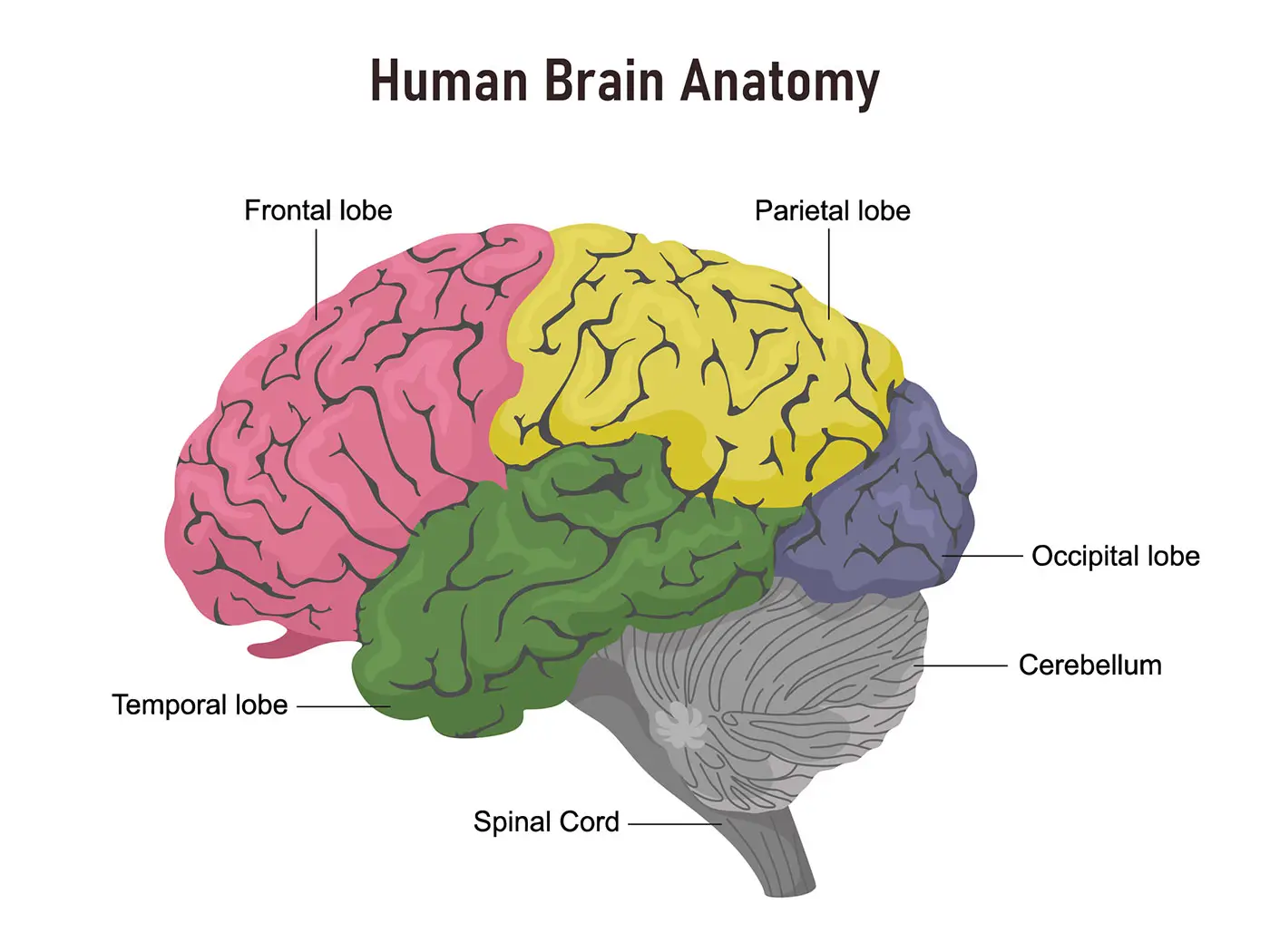
The Frontal Lobe
The main function of the frontal lobe is linear thinking; another name for the frontal lobe is the prefrontal cortex – both names have an indicator of their location in the brain. Scientists believe that the seat of consciousness is in the frontal lobe, as it is believed to be involved in personality emotions, intelligence, attention and concentration, judgment, body movements, and lastly, problem-solving. Individuals who have trouble with focus and attention (such as attention deficit disorder (ADD) often have decreased functioning in the frontal lobe.
The Temporal Lobe
The temporal lobe is located at the temple and behind the ear. It is involved in hearing, memory, sequencing, and organization. This lobe allows us to have an understanding of the languages we use for communication. Those with mood and memory issues often have impaired functioning in the temporal lobes.
The Parietal Lobe
This lobe is located close to the top and back portion of the brain and is involved in the sense of touch, and perceptions (spatial and visual); it also allows us to distinguish size, shape, and color. Using images of the brain, we can see deficits in parietal lobe function among patients with Alzheimer’s disease.
The cells of your brain are comprised of both neurons and glia. Neurons are the nerve cells in the brain – they stay with us for life. Most of them cannot divide, making each one extremely valuable because they could be viewed as irreplaceable. In addition to an inability to divide, we also lose some from chronic exposure to heavy metals, pesticides, and herbicides in our food (and toxic chemicals in our environment). So the air we breathe – one of the main ways we interact with our environment – depletes some of our neurons!
The neurons in our brain are highly metabolic rate, requiring a steady stream of glucose. Ideally, this would come from whole foods, like vegetables and fruit.
The glial cells are support cells, yet they do not have a neural impulse; instead, this support is more like building blocks that give insulation and support to the neurons they patients with Alzheimer’s disease.
The Occipital Lobe
The occipital lobe is in the back part of the brain; it is primarily involved in vision – even visualization emanates from the occipital lobe. During times of visualization, the occipital lobe is activated.
The cells of your brain are comprised of both neurons and glia. Neurons are the nerve cells in the brain – they stay with us for life. Most of them cannot divide, making each one extremely valuable because they could be viewed as irreplaceable. In addition to an inability to divide, we also lose some from chronic exposure to heavy metals, pesticides, and herbicides in our food (and toxic chemicals in our environment). So, the air we breathe – one of the main ways we interact with our environment – depletes some of our neurons!
The neurons in our brain are highly metabolic rate, requiring a steady stream of glucose. Ideally, this would come from whole foods, like vegetables and fruit.
The glial cells are support cells, yet they do not have a neural impulse; instead, this support is more like building blocks that give insulation and support for the neurons they surround. Glial cells comprise nearly half of the total mass of the brain. So, while we know that the human brain has 85 to 100 billion neurons, it also has 10 to 50 times as many glia.
Myelin is a lipid, and it serves to both protect and insulate the actions of axons in the brain. Myelin will increase the speed of neural impulse conduction, reaching an impressive 200 miles per hour.
As mentioned previously, multiple sclerosis (MS) is considered a rare condition, caused by the loss of this protective myelin sheath around the neurons. This loss significantly impairs neuronal communications. In fact, it is neuronal communication that impacts our behavior. Later, we will learn more about the ways neurons are wired in the brain and how they direct our thoughts, actions, and behaviors. As a coach looking to help guide a client through behavior change, this is useful to know because It is through the rewiring of neuronal communication that we can achieve our goals.
But neurons don’t work in isolation; they communicate with other neurons, muscles, and glands at junctions known as synapses which are spaces between two cells where chemical messengers called neurotransmitters are released this is a powerful impact on how we feel.
Neurotransmitters
Neurons are very powerful, as they have the potential to create anywhere from 10,000-40,000 synaptic connections. This alone illustrates the tremendous complexity of the central nervous system that we rely on for life. Neurotransmitters (NTs) are the naturally occurring chemicals inside the body that transmit messages between cells; as such, they control almost every function of the body and are important in regulating mood, memory, ability to learn, and overall brain function. There are hundreds of different neurotransmitters in the brain.
Some neurotransmitters are more well-known than others, and these include some main NTs most often referenced in the literature that health professionals both read and write about. For this course we focus more on the following neurotransmitters in our presentation:
- dopamine
- serotonin
- norepinephrine
- gamma-aminobutyric acid (GABA)
These neurotransmitters are directly involved in your ability to focus, concentrate, activate pleasure centers, regulate your mood, give you energy, enhance mental alertness, and relax the body. Obviously, a coach can see the importance of knowing these neurotransmitters. It is also interesting to note that most mental illnesses and cognitive dysfunction involve abnormal synaptic activity of one or more brain neurotransmitters listed above.
The human veritable chemical factory, produces serotonin, dopamine, and other vital neurotransmitters for life to be what it is. It then becomes vital to consume the brain is a raw nutrient at appropriate concentrations in order to generate these chemicals. Additionally, combinations of amino acids, vitamins, minerals, and biochemicals from foods providing these raw materials must be in appropriate balance to synthesize the neurotransmitters we rely on for homeostasis. Current research supports a belief that a low level of any of our brain’s neurotransmitters is now reaching epidemic status.
Learn More About Becoming a Certified Brain Fitness Coach
You can now dramatically expand your knowledge of brain optimization through proper training, sleep, nutrition, neuro-conditioning, and flow state. Start your career a Certified Brain Fitness Coach.
NESTA and Spencer Institute has been helping people like you since 1992. To date, over 65,000 people from around the world have benefited from our various certifications, programs, continuing education courses and business development systems. We are here for you now and in the future. Feel confident in your decision to work with us as you advance your knowledge and career. We are here for you each step of the way.
Our programs are open to anyone with a desire to learn and help others. There are no prerequisites.
That’s it for now.
Take action!
PS: Click here to see many helpful business/career resources