When we are accessing the information from both hemispheres of our brain – we are doing holistic thinking and can generate more success, balance, and congruence by having awareness of each perspective. This is a level of distinction that will allow more choice and better results. This is an exercise you will learn as part of your curriculum in the Spencer Institute Life Strategies Coaching Certification Course.
How to Use Both Sides of Your Brain to Reach Your Goals Faster
Accessing your Other Mind’s Eye
Optional Preparation: Understanding the concept of the External Dominant Eye
Look at a spot about 20 feet away with your head facing straight.
While focusing on the spot, simply point at it from the center line of your body.
Close one eye and notice if your finger is still directly on the spot.
Open that eye and close the other. Notice if your finger is still directly on the spot.
The external eye that keeps your finger pointing directly at the spot is your current external dominant eye.
Look at the spot again keeping both eyes open and notice that even though you are seeing the object with both external eyes, you are actually seeing it more dominantly with either the left or right eye.
A back-up procedure for determining the external dominant eye is noticing which eye you use to look through a camera lens, or a telescope.
This step will assist you in recognizing eye sight dominance, which then facilitates an under standing of the experience of internal eye dominance.
Step #1:
Think of a person, maybe a movie star or political figure, and notice your internal image of this person.
Step #2:
Note the specific qualities of the image:
a) Visual—color or black & white, size, location, clarity, movie or still, full-body, torso, or face, a particular background, if any
b) – external – sounds coming from the image internal- internal – auditory thoughts as you look at the image
c) Kinesthetics—physical sensations in your body as you look at the image
d) Meta-Kinesthetics—Your emotional evaluation associated with the image
Step #3:
Notice, or simply get a sense of, which internal eye you are using more dominantely to access this internal picture.
Step #4:
Now, in a way that works for you, shift so that you are now thinking of that person using the image that comes up with your other internal mind’s eye. (Covering the eye you first saw the image of a person will help to make the shift.)
Step #5:
Note any changes in the way this second image is represented:
a) Visual—color or black & white, size, location, clarity, movie or still, etc.
b) Auditory – external – sounds coming from the image – internal – auditory thoughts as you look at the image
c) Kinesthetics – physical sensation in your body as you look at the image d) Meta-Kinesthetics – Your emotional evaluation associated with the image
Right brain or Left Brain Lead Processing Filters
You have already have the information that each hemisphere of the brain has its own cognitive style of processing information. Now we will find out how to access all of the information being stored internally from each side of the brain.
As unique individuals, we each have a “hard-wiring” in the brain that guides us to process first through the cognitive style of one side of the brain more dominantly or the other. As a coach, this is a hugely valuable tool to know how you can best guide this person. There are several ways to calibrate how a person is hard-wired.” The most reliable and consistent is a simple procedure.
For a moment put down whatever you are doing with your hands and clasp them together with your fingers inter-laced. Now notice which thumb is on top, the right or left. Because the right hemisphere of the brain influences the left side of the body, if your left thumb is on top – you are wired as a “right brain lead.” Conversely, if your left thumb is on top, you are wired as a “left brain lead.” Therefore, left thumb on top people will naturally process the world and their experiences with the cognitive style of the right hemisphere first. Right thumb on top people will naturally process the world and their experiences with the cognitive style of the left hemisphere first.
Let’s use walking as a metaphor. When we intend to walk, we take the a first step. Then to make progress to our intended destination, we take a step with the other foot, and so on. Otherwise, we would be hopping down the street. In the brain, we will lead with one hemisphere in filtering or processing information, and to have balance, or whole brain thinking, we then process the same situation or experience with the cognitive filters of the other hemisphere.
This information useful as a coach because making this calibration, now you can communicate more precisely with your client and make sure they are processing in a balanced way.
Enhancing Strategic Processing Filters
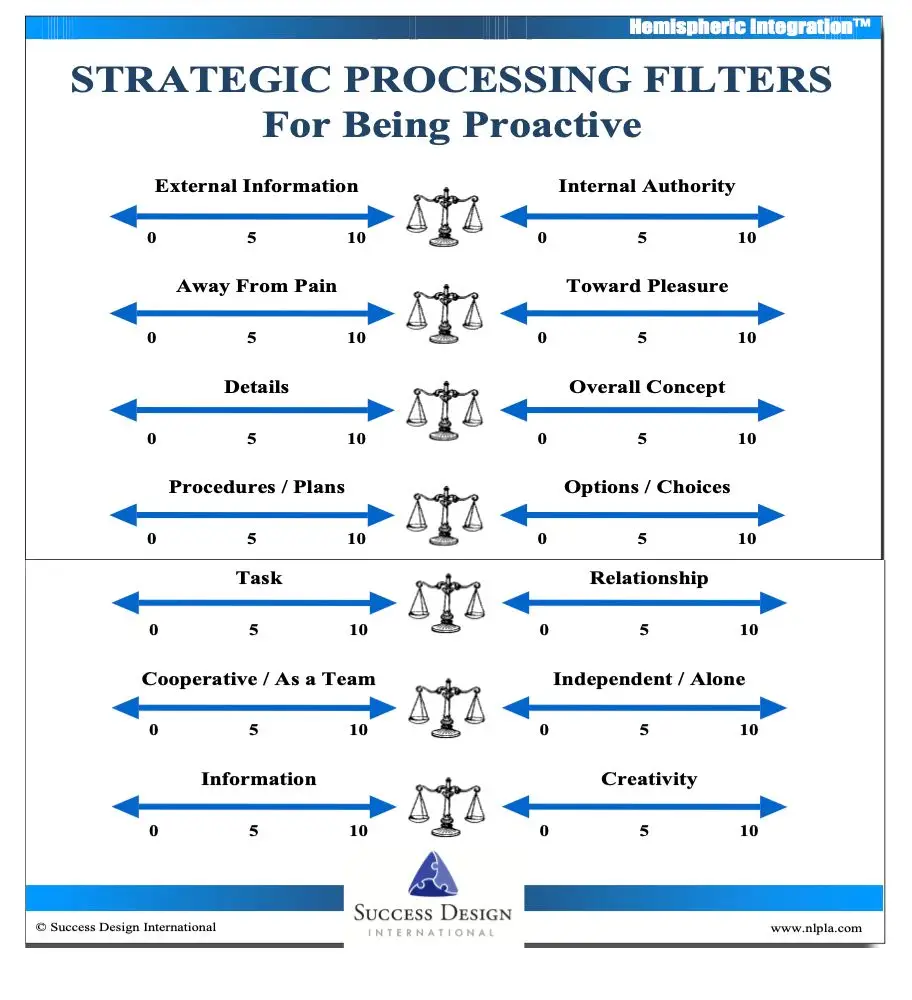
The following chart show us the continuums of thinking filters in the brain that will serve us well when we can utilize these filters to our advantage and on purpose. Each person has the capacity to think through each side of the continuum. It is when we get “stuck” in one end or the other that we have our challenges in life. For instance, in motivating our clients, it is important to be sure they are moving away from pain or danger or old patterns that no longer serve them and moving toward pleasure or their goals and passion as you see in the second continuum on the chart.
The chart as shown defines the filters of how to best be Proactive so we don’t fall into Reactive powerlessness. The qualities on the left side of the chart are the natural filters for the left brain and the perspectives on the right side of the chart are the natural filters for right brain processing. When influencing a client, knowing which lead system they are you can best guide them in the way you interact by how you focus your information and suggestion in a way that they can best understand and be motivated to respond.
Language for Effectively Making A Request or Delivering a Proposal
When making a request or proposal there are two elements that will make the statement complete: the benefit and the facts; the task and the relationship; the big picture overview and the details of the information. Often, some people are not aware of this and deliver only 1⁄2 of the information, for instance, leaving out the details/facts or not honoring the relationship. Then they are puzzled as to why they are not as consistently successful as they would like to be in influencing, guiding and getting the wanted results. So, the first step is to be aware and then create a request/proposal that encompasses both sides of the Strategic Processing Filters.
When delivering a statement it is important to be aware that communication will be most effective when sent in the way the right brain lead or left brain lead naturally processes the information. The state of the being of the person delivering the information is also an important influence on the listener’s experience, as well as the receiver’s emotional belief filters.
Right Brain Lead: Big Picture → Benefit → Relationship → Details Facts Task
Left Brain Lead: Details → Facts → Task → Big Picture Benefits Relationship
Examples:
1. It will be so much fun if we could go to the movies together on Friday at 7:00 _______________ movie is playing at the ____________ movie theater.
2. Our product will increase your overall health and vitality when you take one capsule daily with food.
3. Having quality time with you is my favorite part of the weekend, so let’s spend just an hour getting the kitchen and bathrooms done quickly.
Examples;
1. On Friday at 7:00 _________________ movie is playing at the ___________ movie theater, it will be so much fun if we could go together.
2. Our product is most effective when you take one capsule daily with food and it will increase your overall health and vitality
3. Let’s spend just an hour getting the kitchen and bathrooms done quickly because having quality time with you is my favorite part of the weekend.
Make multiple opportunities for yourself to practice this important communication tool until this style of respectful processing is just automatic for you.
Representational Systems – Modalities Introduction to physiological, linguistic and behavioral cues observable in others.
“All Communication is Redundant.” We process in all systems simultaneously – learn the non- verbal and verbal calibration for identifying congruency or incongruency.
The Major Sensory Characteristics of the Representational Systems or “Modalities”
In Hemispheric Integration and neuro-linguistics we refer to each of the major sensory representational systems as a “modality.” For example: The eyes are the organs which receive light, convert the light to nerve impulses, which are then interpreted by the brain into what we call “pictures.” Your brain is what makes the pictures, not your eyes. We call this the “visual system or visual modality.”
Each sensory modality best represents that aspect of the world to which it corresponds directly. People often get into trouble by representing an experience with the inappropriate sensory system. For instance, if the task is to select people to answer telephones in a customer service department and to have them interface with customers using sounds and words, then choosing an auditory screening method is much more effective than using a visual one. The funny thing is, if an employer primarily process in the “visual” modality she will naturally screen applicants for such a job with an unconscious preference toward visual characteristics: neatness of attire, grooming, and gestures, etc., rather than by listening to the applicants auditory attributes such as voice, tonality, pitch, and breathing rhythm.
The major modalities include: Visual, Auditory, Kinesthetic, Gustatory and Olfactory. The last two are often referenced with the Kinesthetic system for simplicity.
Secondary vs. Primary Experience
“Digital” or word descriptions, are secondary experience: They describe something that exists in another form. As such, they always contain much less information than the raw primary experience (such as a picture or song) which they describe. Auditory digital (talking to one’s self) is particularly good as a kind of filing system – for keeping track of personal experiences, categorizing experiences, or for making plans and setting a direction.
Strategies often begin with an auditory digital question that the rest of the sequence is designed to answer.
Examples include:
“What do I want to eat?”
“What do I want to learn?”
“How can I chunk this task down?” “What would be fun to do?”
Auditory digital is also good for summarizing, for providing a running commentary on the raw data, or a conclusion.
Such as:
“That’s a good idea.”
“Yes.” (or “No.”)
“That one is too expensive.” “You’ve GOT to be kidding!”
Auditory tonal can add impact to the evaluative comment and can help flesh out the raw data considered. Examples are tonal expressions such as “Hmm,” “Arrgh,” “Phew,” etc.
Unique Characteristics of Representational Systems
Each major representational system has its unique qualities. The visual system can represent an enormous amount of data simultaneously and instantaneously.
The auditory system is sequential, meaning that whatever data is processed is done sequentially one item at a time. Thus, any auditory processing inevitably takes somewhat longer than visual processing.
The kinesthetic system has much more duration than the other two. You can change internal pictures very quickly, change a sound fairly quickly, and feelings change much more slowly. This is because of the physiological inertia of the kinesthetic system. If you have ever gotten angry and then discovered that you misinterpreted the reason for your anger, you know that the physiology of anger took a few seconds to diminish to normal levels. You didn’t go from “anger” to “laughter” instantly. This is simply because it takes longer to change your internal physical chemistry.
These tempo differences are clearly demonstrated by people with more extreme representational system preferences: Imagine a quick highly visual person, a slow kinesthetically inclined person, and an intermediately paced auditory person in a room together and ask each of them for directions to Disneyland!
It’s difficult to fully represent the outcome of a strategy using only sounds, words, or feelings. The visual system is usually essential. You can see different pictures of several possibilities simultaneously, make direct comparisons, or see a sequence of steps all at once. You could even make one picture of all the different steps you need to take to accomplish an outcome. If you had to run through all those steps kinesthetically (physically), or describe the steps auditorily, it would take much longer.
All systems together give you a full representation and information much more than any one or two systems. One of the main benefits derived from studying neuro-linguistics is fine-tuning our awareness and access to all systems easily and automatically.
Kinesthetic tactile (touch, temperature) and kinesthetic proprioceptive (body position, visceral sensations, movement) can help provide important raw data in a strategy involving the body.
Meta-Kinesthetic (emotions – “I feel happy.” “I’m confused.” “that was good.”) is the primary way people evaluate their internal experience or thinking.
Representational Systems Predicates
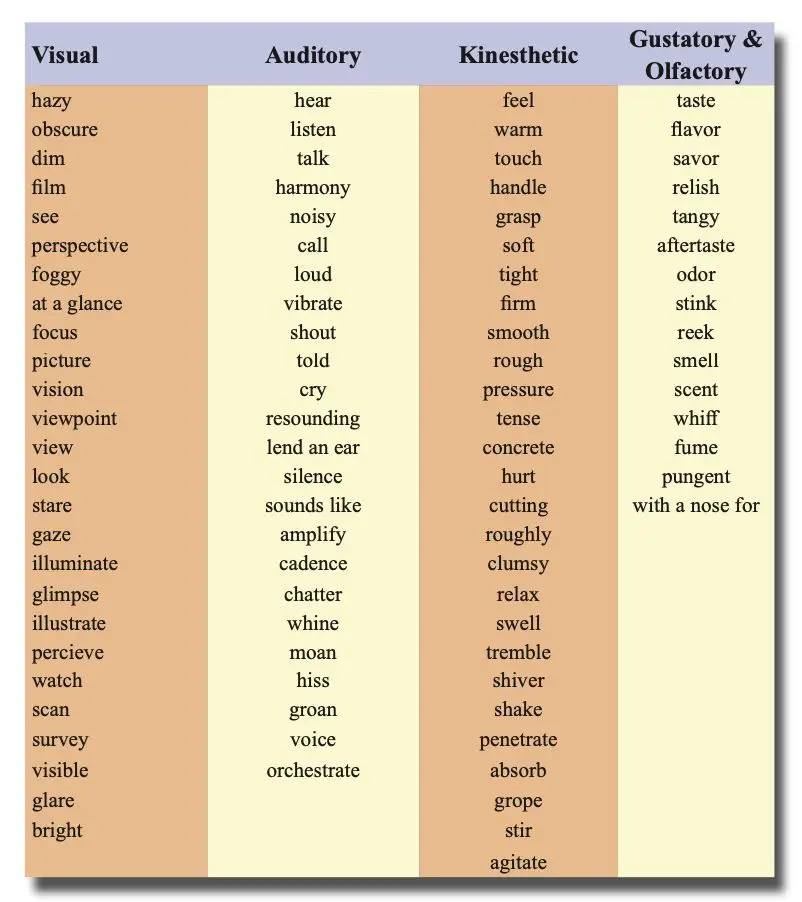
Predicates are the process words (verbs, adjectives, adverbs) which people use to communicate about their experience (or model of the world). If you pay attention to this information, you can alter your own behavior and your choice of words to “match” the predicates being used by another in order to acquire increased understanding of how they are representing their experience to them-selves. Predicates reveal what part of an experience is most relevant to the speaker at a particular point in time. If you want immediate rapport and trust with someone, one of the things you can do is to “match” them, speaking in the same kind of predicates in which they are speaking.
Examples of Common Predicates
If a person represents his/her experience visually, then they will speak in visual predicates. Many of us speak in the same predicates as others naturally, thus we find ourselves “matching” one another, deeply absorbed in conversation; and yet there are times when we “mismatch” and wonder what we said that “offended” the other person. Herein lies one difference between those people who are able to establish rapport and trust and those who are not.
Unspecified Predicates
Predicates which do not indicate any of the sensory input channels are UNSPECIFIED. That is, they are unspecified as to just how the process is being represented or executed -whether in pictures, smells/tastes, feelings, or sounds.
Some examples of unspecified predicates are:
think
nice
remember
learn
trust
change
intuit
consider
know
believe
respect
understand
When presented with such words there are several options for determining how the experience is being represented. One choice is to ask, “How, specifically, do you think (know, understand, learn)?” This will elicit a verbal response richer in process details, or a non-verbal behavior, such as an eye accessing pattern, which will specify the sensory representational system being used.
As a coach, presenter, teacher or manager of a group, these unspecified predicates allow members of the group to process in their own particular style. Other times, when being directive and wanting the whole group to process in a particular modality, use specific predicates.
Skill Building Exercise: Identifying Visual Predicates
1. Find a section of the newspaper or a magazine. Choose a specific color marker for each modality (VAKOG). Start with visual and go through at least three different articles and mark the visual predicates. Repeat for auditory, then kinesthetic predicates. Now scan for the unspecified, neutral or digital words.
What differences you find in each author and the topic being discussed?
Skill Building Exercise: Identifying Auditory Predicates
1. Watch and listen to talk shows both on radio and on TV and begin to get more competent in identifying what predicates are being used by the host and guest.
2. Listen in conversations and notice if you can pick up on the processing style of a person by identifying the predicates being used in a particular context.
3. Practice speaking in a particular modality or unspecified predicates only, then expanding to a full range of blended choices.
a. Practice your fluency by telling about an experience – either to a friend or into a tape recorder. Begin as you normally would for 20 seconds, then switch to visual predicates for another 20 seconds, then switch to auditory predicates for 20 seconds, and to kinesthetic, olfactory, gustatory predicates for 20 seconds.
If there is one modality that is more awkward for you – task yourself to practice this one more to establish your verbal dexterity.
b. With a friend practice identifying and then matching the predicates they are using and in the sequence they are being used.
Representational Systems in Conversation Visual:
“I see what you are saying.”
“That looks good.”
“That idea isn’t clear.”
“I am hazy about that.”
“I went blank.”
“Let’s cast some light on the subject.”
“Get a new perspective.”
“I view it this way.”
“Looking back on it now, it appears differently.”
“An enlightening (insightful, colorful) example.”
Auditory:
“I hear you.”
“That rings a bell.”
“It sounds good to me.”
“Everything just suddenly clicked.”
“Listen to yourself.”
“That idea has been rattling around in my head.”
“Something tells me to be careful.”
“I can really tune in to what you’re saying.”
Kinesthetic:
“It if feels right, do it.”
“Get a handle on it.”
“Do you grasp the basic concept?”
“Get in touch with yourself.”
“I have a solid understanding.”
“I am up against a wall.”
“Change your standpoint.”
“You are so insensitive.”
“I have a feeling you’re right.”
“I am boxed in a corner.”
“He is under my thumb.”
“They really put the screws to me.”
Skill Building Exercise: Conversational Predicate Phrases
Begin to get comfortable in hearing the predicate phrases and representational systems that describe how a person is perceiving a situation. You will begin to build the skill to hear the “metaphor” or underlying presuppositions the other person is thinking through. Then practice being able to pace and lead in the conversation to reach the desired outcome and maintain rapport.
Submodalities: Building Blocks of Internal Experience
Components of the Representation System Modalities. Submodality Distinctions – V, A, K, O, G and Meta-K – (Evaluation and /or Emotion)
Submodalities are the smaller elements or components of internal processing within a modality or representational system. The list below is far from complete and the order of listing is irrelevant. Some of the distinctions listed are actually combinations of more basic distinctions: for instance, “sparkle” is made up of brightness, location, and duration. What distinctionsdoyoumakeinyourownprocessingthat you can add to this list?
Basic Submodalities
The following is a list of the most notable or common submodalities that most people notice within their internal representation of a thought or of a memory.
Visual
Projected location (where in space the image appears)
Event location (pertinent background or context represented within the image)
Size (relative size of the image within the visual field)
Associated (viewing from in the experience) / Dissociated (observing the experience) Color or Black and White
Movie or Still Image or Photograph
Framed or Panoramic or Floating
Brightness
Flat or 3 Dimensional
Clarity
Other Visual Submodalities
Hue or color balance Direction of movement Strobe
Symmetry
Shape
Magnification
Contrast
Direction of lighting
Horizontal or vertical hold Transparent / Opaque
Aspect ratio (height to width) Orientation (angle, tilt, spin, etc.) Density (“graininess” or “pixels”), Saturation (vividness)
Auditory
External (generated as a part of or coming from an image) Internal (generated as an internal response to perceiving an image)
The actual words or sounds Volume
Rhythm
Monaural or Stereo Tonality
Clarity
Other Auditory Submodalities
Pitch
Location
Symmetry
Distance
Flow
Tempo
Number
Duration
Resonance
Contrast
Kinesthetic
Tactile (skin senses)
Proprioceptive (movement, balance, posture, breathing, internal visceral sensations) Location
Pressure
Duration
Movement
Intensity
Temperature
Balance
Other Kinesthetic Submodalities
Frequency
Extent
Equilibrium
Fuzzy
Muscle tension
Texture
Shape
Smooth
Olfactory and Gustatory –
Words that describe experiences in terms of smell and taste. These experiences are often linked in with the Kinesthetic system. Odors and tastes are very powerful anchors for states of being.
Odor
Fragrance
Intensity
Duration
Fading in or out
Other Olfactory and Gustatory Submodalities
Acrid
Sweet
Pungence
Burnt
Sour
Salty
Aromatic
Bitter
Tasty
Meta-Kinesthetic (Meta-K) –
The evaluation about, or the culmination and results of the internal representations from the Visual, Auditory and Kinesthetic, Olfactory and Gustatory systems. This is also experienced as emotions or visceral feelings. The physical sensations are often represented in the abdomen and chest or along the mid-line of the torso. These feelings are evaluative secondary physiological representations derived from other sensory perceptions.
Using Representation Systems and Submodality Information
As a leader and coach, one of our primary responsibilities is to guide and bring about change. In the process of pacing (aligning with, matching, and understanding the map of reality of another) and then leading (guiding, facilitating and teaching tools for change), having awareness of our own internal processing and then eliciting the internal processing of another, provides core data.
Then with this data, which has accumulated from past experiences and the beliefs created based on the internal processing of the world around us, we have a structure to work with and create measurable results.
When doing Hemispheric Integration processes and using the technology in the field, these primary patterns of thinking, unique to each individual, provide us with the information we are seeking as good detectives looking for the structure of the challenge and the structure of the desired future.
We have established the importance of gathering all of the information in an internal experience from both hemispheres of the brain – thus Dual Influence Processing. This gives a holistic and full brain as a resource to create change. The Unhooking from People who Push Your Buttons process is used to create possibilities within each individual as to how they choose to respond, interact and set boundaries in their life experiences. Please see pages 69-88 in the Other Mind’s Eye text for more details and description. This process was originally called The Internal Dominant Eye Accessing Foreground/Background Process as you will see in the text. Over time, we’ve established the more user friendly name of
“Unhooking from People who Push Your Buttons.”
Purpose: For the Explorer (client) to soften their initial internal response or negative reaction to a challenging person or situation, while maintaining the ecology necessary for safety. From this new awareness, the client will have the options of how to set boundaries and interact with this person in a way that creates more personal choice and safety.:
1. Establish rapport, psycho-geography, and relationship of safety for working together.
2. Have Explorer think of a challenging person with whom they would like to have a more resourceful initial internal response or reaction.
Examples: Supervisor, co-worker, relative, neighbor.
Guide says, “When you think of that person, what image comes up?”
3. Elicit the way the Explorer experiences the person now. Pay particular attention to: Visual – Associated or dissociated, clarity, color or black & white, movie or still picture, panoramic or framed, size of picture, distance and location, full body or head & shoulders?
Auditory – External sounds coming from the image—voices and background sounds, content of words, volume and tonality.
4. Internal personal comments about the image—content of words, volume and tonality.
Kinesthetic – Physical reactions in the body when the person looks at the image. Emotional response – Word or short phrase that represents the overall emotional response when the person looks at the image.
Guide says, “Get a sense of which internal mind’s eye you are seeing that picture with more dominantly.” Note Explorer’s response. Guide says, “Now, set that image aside – we’ll come back to it in a moment. After checking inside, and in a way that is just right for you, shift your attention to your other mind’s eye, so that you will be seeing that person now with the information coded in your other hemisphere.”
Note: Often covering the eye and taking a breath will assist in shifting to the other hemisphere. Guide observe any change in the Explorer’s physical response to the second image.
- Elicit any differences in how the pictures are perceived, paying close attention to any shift in emotional response.
- Have the Explorer identify which picture gives them the most choice of responding resourcefully. Have the Explorer make this image primary or foreground, and leave the less resourceful image background or secondary. “In a way that works for you, have your unconscious mind hold these images co-consciously; the one that lets you feel most resourceful be primary; and have the other image be secondary. This will preserve all of the information you now have about this person.” Keeping both pictures preserves important information and is therefore more ecological.
- Assist Explorer in establishing primary image and secondary image by asking them, “What would make the more resourceful picture stand out or come upfirst?” Test for response and adjust as appropriate.
- Caution: Doing this process sometimes allows deeper or connected issues to surface, such as limiting beliefs or negatively charged memories. These can then be dealt with using other Hemispheric Integration and neuro-linguistic techniques now, or at a later time. Check to see what follow-up work may be needed and make a note to do so.
- Guide tests the Explorer’s new response by asking, “When is the next time you will think about, or be with this person, and you want to have your new response?” Have the Explorer imagine being with the person, and calibrate their nonverbal response. What boundaries might they want to set for their own safety?
- Future pace the new choices the Explorer now has to adjust their internal dominant eye accessing with this person in the future. Also let the Explorer know that you are helping them create new neural pathways they will access more and more automatically with others in the future.
Learning Opportunity: Dual Influence Process
Practice doing the process of Unhooking from People who Push your Buttons with five different people. Use the Hemispheric Integration Techniques Demonstration video in the Life Strategies Coaching Certification as a live example of the process.