Hemispheric Specialization of the Brain
When we understand the cognitive functioning of each hemisphere we can be more purposeful about how we process information – when a challenge is more of a right brain issue, or when the left hemisphere’s style of thinking will give the best results.

Another phenomena we have discovered is that as human beings we each have a built in, hard- wired right or left brain lead. All that this means is that when we approach a topic, or in conversation, we begin in one hemisphere to process and then include the other hemisphere. The more balanced we are in this back and forth fluidity, the better we are at being an exquisite communicators.
One physical test for discovering from which side you begin is to naturally clasp your hands and notice which thumb is on top. If it is the left thumb on top – you are a right brain lead, and if the right thumb is on top – you begin processing in the left side of your brain. How this is important is as an indicator of someone’s preference and style in sending and receiving information. When we can elicit a person’s lead – we can make some basic assumptions on how to more successfully communicate with them.
Motor Response and the Hemispheres
The left hemisphere of the brain governs the right side of the body and the right hemisphere of the brain governs the left side of the body. The sense of smell does not cross over however; the right nostril goes directly to the right hemisphere and the left nostril goes directly to the left hemisphere, which may account for the powerfulness of scents and aromas as anchors or triggers for remembered experiences and states of being.

Ultradian Rhythm for Face Lateralization
The Ultradian Rhythm of moving from one hemisphere to the other, as seen in a person’s face lateralization, occurs naturally about every 90 minutes. By being able to calibrate the face, this will indicate which side of the brain a person is processing in more dominantly in that moment. This is useful to notice as a communicator. Since the processing filters of the two hemispheres are quite different, your ability to have this knowledge will help you to be most respectful of a person’s style of thinking and to present information and influence in their mode.
The side of the face that has the most space between the eye and mouth, has the widest opening eye and lifted eyebrow and is most relaxed, is open to receiving information from the outside world more dominantly, which activates the opposite hemisphere for processing.
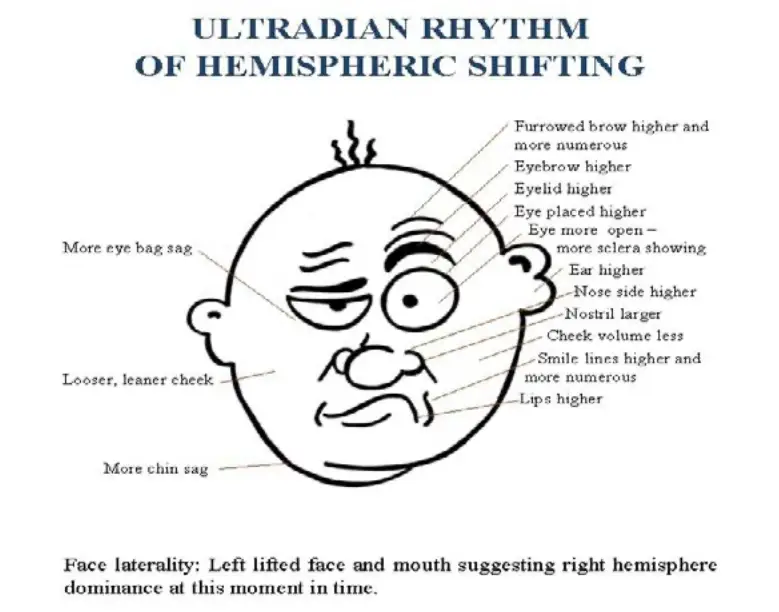
The side of the face that is more tense, the eye opening is narrowed slightly, and the space between corner of mouth and edge of eye is slightly contracted indicates that this is the same side of the brain the person is more dominantly thinking in at the moment.
Coaching Exercises as Skill Drills
Purpose: To build in your automatic awareness for the hemisphere a person is processing in at the moment. As a communicator, you can then present information in the style the other person is most likely to receive it most effectively.
- From now on in conversation, when you are watching movies, or TV, make it a practice to just notice which hemisphere a person is processing in more dominantly in the moment.
- When you spend several hours with someone, about every 30 minutes check to see if you notice a shift in the face laterality of that person. When you do see the shift, notice the timing for when it shifts back. Also pay attention to what else shifts in the conversation as far as topic, mood, language, etc.
- When a person is in their left eye (more open) – this is the cognitive style of the right or relationship hemisphere. When a person in more in their right eye (more open) – this is the cognitive style of logical, linear thinking of the left hemisphere. Use your language skills to influence this person according to the style of thinking of that hemisphere.
Getting Started
This article was written by Al Sargent and Marilyn Sargent of Success Design International. They are the authors of the Spencer Institute’s Life Strategies Coach Certification and the Results Coach Certification.
If you found this article helpful, you will want to click over it and get more information on how to use this in a coaching setting. For more information on Al and Marilyn, visit www.repoweryourlife.com