

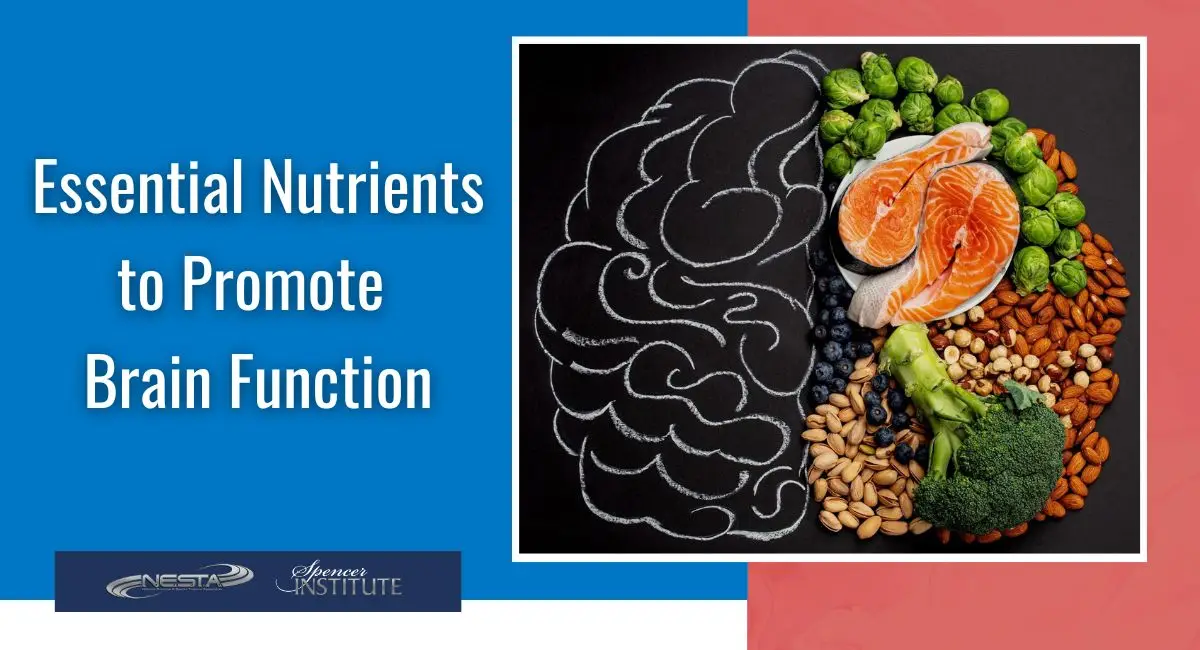
The Effects of Nutrients on Brain Function
Optimizing brain health is on trend. A well-functioning brain creates more opportunities for success in each aspect of life. Discover the fundamentals of nutrition for optimizing brain health and function for yourself and coaching clients.
Hydration
An important fact to know is that 80-90% of our brain mass is water. When we experience dehydration, the first organ to be affected is the brain – which is why hydration is critically linked to optimal brain function. A proper hydration level allows for the important balance of minerals across the cellular membrane, thus allowing it to hold the proper charge so that it maintains optimal functioning. But we also need proper hydration to ensure that the cells receive life-sustaining nutrients and the removal of toxic waste from the brain.
A client who does not consume enough water to maintain adequate hydration for their brain will not function optimally. One concern with under-hydration is the toxic waste build-up in the cells of the brain; this is typically the culprit behind fatigue and brain fog – two of the most common concerns of people over the age of fifty. Increasing water may be one of the easiest ways to inspire your clients to improve how they feel. When we can consume water consistently throughout the day, we are more able to naturally address this decline in function.
Essential Fat
Science and research have shown that up to 60% of our brain is comprised of essential fats. Our brain contains cells called neurons, and these neurons are comprised of a cellular membrane that is made up of essential fatty acids.
The very real reason behind wanting essential fatty acids in our diet is to allow the cellular membrane to have a porous structure, allowing essential minerals to easily flow in and out of the cells. This flow creates an osmotic balance and the maintenance of the proper charge of the cellular membrane.
The fatty nature of our brain makes a compelling reason supporting the need to incorporate essential fatty acids in our diet.
Later, we will address the topic of fatty acids from plant and animal sources, as well as other nutrients believed to support a healthy cell membrane structure.
It is interesting to note here that consumption of saturated fats from processed foods is seen to result in negative effects on the cellular structure and the cell membrane potential. This is believed to be from these fewer desirable fats blocking the flow of minerals and electrolytes across the cellular membrane, resulting in an osmotic imbalance, a change in cellular pH, and, of course, potential negative consequences if not kept in check.
Mineral Salts
Our brain also needs an appropriate balance of mineral salts for optimizing electrical conductivity. These mineral salts, or electrolytes, include sodium, potassium, calcium, and magnesium. Understanding these vital organic substances goes hand in hand with learning both how and why these are so essential to cellular communication in the brain. Hopefully, this informs you as to how important it is that your clients appreciate the need to consume foods that provide these essential minerals.
One example of this need can be explained by looking at most individuals who consume a western diet, known to be low in many necessary minerals; consequently, we have observed severely depleted levels of magnesium. Chronic magnesium depletion disrupts the delicate balance of electrolytes across the cellular membrane. Since this is so essential to health, a CBFC can easily address this by recommending juicing dark leafy greens to provide most of the essential minerals and electrolytes important to the cellular health of the brain.
Glucose
Glucose is essential to our brain’s survival and is critical in regulating its energetic and metabolic demands when the body is well hydrated, you’re supporting your central nervous system so that the brain and the mind become clear.
Knowing that our bodies are made up of nearly 70% water, a well-functioning brain requires 80% of its mass to be comprised of water. This
The body has its own processes that compensate as soon as it feels dehydrated. As soon as the body is dehydrated, it’s also expressed as stress.
A fully hydrated body will allow you to have more energy and to think with more clarity. Water helps to transport nutrients throughout the body, water also:
- helps to regulate the body’s temperature
- manufactures hormones and neurotransmitters
- lubricates the joints and acts as a shock absorber for the brain and spinal cord
- helps to convert food to energy it
- delivers oxygen throughout the body
- is the major component of the mass of most of your body’s organs
This makes the brain have the highest proportion of water than any organ in the body. When dehydration sets in, the brain is the first organ to be impacted. Water is life and without it, no human or plant could survive. When this vital fluid is low, the ability to think clearly becomes compromised and health is also impacted.
The health of the body is linked to the permeability of cellular membranes, so it’s important that the body correctly utilizes oils as the lipid cell membrane requires oils or essential fatty acids to function correctly.
Lipids/Fats
It is believed that our brains are composed of up to 60% fat; therefore it’s essential that we consume adequate amounts of healthy fats in order to support optimal brain function. Omega-3 and omega-6 are the only essential fatty acids for humans. The body can produce omega-9 from omega-3, so this isn’t considered essential.
Evidence from human and animal studies indicates neurocognitive development is influenced by various factors including nutrition. It’s been suggested that deficiencies of omega-3 fatty acids can have adverse effects on cognition. Some sources of omega-3 fatty acids include:
- fish/seafood
- flaxseed
- hemp
- sunflower
- pumpkin seeds
The items listed above are examples of foods that are broken down by the body into EPA and DHA; DHA is the core component of omega-3 fatty acids; it is highly concentrated in the brain.
DHA has also been found to be important for neurogenesis, the growth of new neurons, as well as for neuroplasticity, neuronal survival, cellular membrane integrity, and fluidity. It’s also implicated in synaptogenesis, known as synaptic transmission. Learning and memory are also impacted – thus explaining its impact on cognition. The oils we consume are important in keeping the structure of the cell membrane intact and in turn, influencing and transforming health and well-being. Fats are essential for mood, learning and memory cellular membrane stability, and fluidity.
Vitamins and Minerals
Vitamins and minerals are essential to life – that much is obvious. Often, nutrients are often thought of as micronutrients because they are needed in very small amounts for life. But the body needs electrolytes to function properly; there are four main electrolytes, that serve to help the body to perform optimally, including sodium, potassium, calcium, and magnesium. These electrolytes are important in helping move water throughout the body. Sodium and calcium sit outside of the cell in the extracellular fluid in their natural position when they cross the cellular membrane and move inside of the cell. They also work to then displace potassium and magnesium when sodium and calcium build up in the cell. The intricate balance of these mineral salts is very important in regulating many of the cycles in our body.
Essential mineral salts include:
- calcium
- copper
- iodine
- magnesium
- manganese
- phosphorus
- silicone
- sodium
- sulfur
- zinc
These salts are important for many essential functions in the body including electrical conduction, metabolism, water balance, bone health, and optimal brain function.
If you think about the development, speed, and power of our brain, it is daunting to realize its capabilities. For example, during fetal development, the neurons in our brain develop at a rate of 250,000 per minute. Our brain continues its growth phase until the age of 25 when it reaches maturity. Therefore, researchers and experts in the field prefer to tell parents that our children’s brains are still developing at age 18 when they’re legally considered adults – so it’s often necessary (or important) to continue to guide them in decision-making well into their twenties.
Myelin and Myelin Sheaths
As mentioned earlier, the speed at which neurons can send signals is 150-200 miles per hour; a neuron can send a signal at about 50
meters per second – which is approximately 100 miles per hour. This accelerated speed is attributed to the myelin sheaths that wrap around the neurons for this to occur with such efficiency.
Myelin is a fatty substance that acts as an electrical insulator, increasing the speed at which a signal is sent. A highly myelinated nerve cell can send a signal at up to 120 meters per second or 270 miles per hour. The speed at which a neuron sends a signal is dependent on a specific neuron’s function and the level of myelination it has. When the myelin sheath becomes destroyed it can result in a degenerative disease – known as multiple sclerosis. This is because the nerve conduction is short-circuited due to a hardening of the neuronal sheath.
Learn More About Becoming a Certified Brain Fitness Coach
You can now dramatically expand your knowledge of brain optimization through proper training, sleep, nutrition, neuro-conditioning, and flow state. Start your career a Certified Brain Fitness Coach.
NESTA and Spencer Institute has been helping people like you since 1992. To date, over 65,000 people from around the world have benefited from our various certifications, programs, continuing education courses and business development systems. We are here for you now and in the future. Feel confident in your decision to work with us as you advance your knowledge and career. We are here for you each step of the way.
Our programs are open to anyone with a desire to learn and help others. There are no prerequisites.
That’s it for now.
Take action!
PS: Click here to see many helpful business/career resources

