What Coaches Should Know About Mental Health, Injuries, Overtraining and Stress
We all know by now that the appropriate quality and quantity of exercise can significantly contribute to physical and mental health. On the contrary, too much or excessive exercising has a detrimental effect on health. Exercise can cause dependence when the person’s thoughts are only revolving around exercising, even when they are not exercising.
What is Exercise Dependence?
Exercise dependence is a form of obsessive-compulsive disorder. The individual’s physical, psychological, and social functioning is severely affected, and they can have withdrawal symptoms. This can cause the client to develop a tolerance for exercise, and therefore they need more and more to be satisfied with the results.
Psychological skills can provide invaluable help to overcome this as well as help recovery. Injury rehabilitation using certain psychological skills like mental imagery or relaxation is reported as having higher adherence rates and speeding up recovery. (Hamson-Utley et al., 2008)
Exercising can sometimes lead to injuries. Psychological skills could also provide invaluable help to overcome this as well as help recovery. Injury rehabilitation using certain psychological skills like mental imagery or relaxation is reported to have higher adherence rates and also speed up recovery from an injury (Hamson-Utley et al., 2008). Regular exercise behavior has positive effects on physical and mental health. Exercise has immediate effects on the mental health of clients.
Here are the most important positive mental influences of regular exercise on:
- Better coping with stress
- Reduced anxiety level
- Prevention or reduction of depression
- Improved mood
- Higher level of confidence
- Better learning abilities
- Better concentration and memory
- Higher work ethic
- Improving creativity
- More relaxing sleep
How long Does it Take for Exercise to Improve Mental Health?
Although effects can appear immediately, to make the benefits of physical activity long-lasting, exercise needs to happen regularly. A certain amount of time is needed to develop long-lasting positive effects and benefits – including a reduction in depression, better neurological Functioning, and increased stress tolerance. From these psychological benefits come indirect physiological changes as well, like lower heart rate and blood pressure and more optimal endocrine functioning.
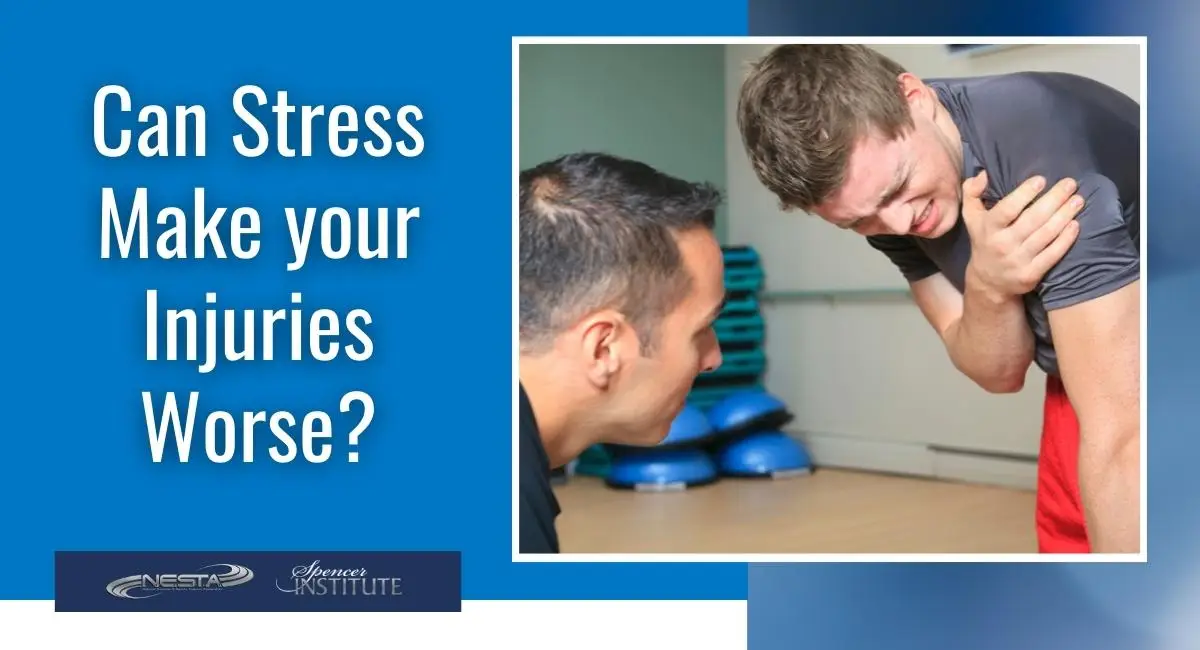
Can Stress Make your Injuries Worse?
Since most trainers do not function in the same way as a Sport Injury Specialist or one who sees injuries frequently, they may not realize how lowering stress levels can serve to keep injuries at bay. In general, most people fail to see this connection, overall. Of course, this isn’t a common point of knowledge for a fitness professional not trained in the influence of stress and exercise psychology. Still, three decades of research show that a combination of conditions puts athletes at a greater risk of injury – this includes negative life stresses, perceived increase in the demands of everyday life, previous injuries, and poor coping responses.
Stress, inadequate coping skills, and personality traits alone do not just make for a bad mood; these factors create an elevated stress response. What does this mean for a client? People who have elevated stress responses suffer from more muscle tension are more easily distracted and have a smaller attention span. This means that your client may not notice that they are not holding their body in the proper form as they execute a movement under your watch as their trainer.
Physiologically, being under stress for long periods of time changes the body’s endocrine system, making a person more susceptible to illness and slowing down the healing process when we are sick or injured.
How to Manage Stress
We all know stress is unavoidable, but how do we help clients manage the stress of life and lower their injury risk? Trainers might have more success if they are able to promote and develop coping skills for the client to use to deal with stress. And if you think about it, what do we know to be the best approach when life hits us with a big stressor — such as the death of a loved one, a change in residence, or the end of an important personal relationship? We seek professional help for our stress. And this is normal if our client’s coping skills are not up to an acceptable level to protect them from the harmful effects of stress.
Trainers, like exercise psychologists, can teach everyday coping skills and help clients to deal with major life stressors. Taking deliberate steps to try and reduce stress can also help to lower the chance of incurring more stress through suffering an injury. But it should note the trainer’s sole responsibility to fix clients in this way.
How Common is Overtraining?
It’s not unusual for clients to push and train according to the slogan “no pain, no gain.” Indeed, this could be a worthy idea for a competitive athlete but for our normal everyday client, it tends to lead to overtraining. Overtraining can be defined as an exercise program that leads to “an undesired outcome of fatigue and performance decrements.” We know from the GAS that this is very real. Now we also know it may have psychological or mental consequences.
Negative effects of overtraining include:
- Muscle pain or soreness
- Weight loss
- Gastrointestinal disturbance
- Overuse injuries
- Loss of self-confidence
- Anxiety Emotional/motivational changes
The easiest way to see if your client is experiencing overtraining is by assessment – such as taking their resting heart rate after a full night’s rest, upon waking up. Some trainers also encourage this practice to be done before the client retires to bed in the evening. Usually, a well-conditioned client will see resting heart rates decrease through positive adaptations to training, but if your program design is overly intense, your client may experience an increase in their resting heart rate. Not only would this have a physiological effect, but it most certainly would affect the client’s mental state as well.
Most clients don’t enjoy (or even feel like themselves) when taking excessive days off from physical activity, as some believe that it detracts from their ultimate goal. The best feature of recovery, though, is that it can take many forms and giving the body proper time to recover is essential to regenerate emotional and physical energy is generally considered to be the easy part of an exercise program design. Try promoting practicing relaxation techniques such as progressive relaxation, autogenic relaxation, or guided imagery.
Think of recovery as just one supporting factor to reduce stress in all areas of your client’s life. For example, if your client is overwhelmed with work-life being too challenging or certain relationships are causing them undue stress, try to encourage the client to lessen or alleviate those stressors during those times when they are not working with you. Without this, clients may see stress as a significant barrier. In most cases, this is a contraindication in terms of their goals.
How Do You Recover From Physical Exertion?
Recovery has three levels:
- physical
- social
- environmental
Eating right, practicing yoga or taking a hike on days off are all practical suggestions for your client to use physically based strategies in order to better recover.
Consider social recovery – meaning that one will participate with people that they like in social activities that are relaxing and rejuvenating. This is often overlooked by trainers because it occurs outside of the environment where work with your client is done.
Environmental recovery can be as simple as changing your training locale. This can also include where the time spent in session with the trainer occurs.
Developing a Client’s Focus
A trainer in tune with the needs of his or her client should monitor the client’s reactions and responses to training variables to ensure that the client is not overtraining. This will help to prevent burnout. The trainer should also try to understand their client’s needs as completely as possible.
Focus, from a client’s perspective, helps concentration and hopefully, competency. The term “attentional field” is used to describe the thoughts, emotions, and physical responses coming from within the client as well as the outside sights and sounds that they are focusing on. Trainers could view this as the ability for your client to attend to internal and external cues of your attentional field at the same time. This will also require practice and cueing from the trainer. When attentional focus decreases, so does the risk of injury or at the very least, poor performance.
A well-coached client knows where to focus their attention on the best results while training. Some people find success through an internal focus style; they will concentrate on their form and technique while training, while being comfortable knowing that there may be distractions or activity in their immediate surroundings.
Other clients who lack this experience of feeling comfortable are far more likely to be distracted and thus, injured. In terms of personality traits, those who are more competitive tend to do best with an external focus style, focusing on outside sights and sounds right up until the moment of exercise execution. During training, they are also aware that if they overthink anything, they may be misdirecting their focus or concentrating too much.
What type of focus works best for your client? Trainers should be able to analyze past exercise experiences with their clients and contemplate the techniques used successfully with them, to have a repeat performance. This should seem logical.
One of the simplest ways to improve focus on your client is to instruct them to place their eyes where you want them to focus. To eliminate external distractions a trainer might encourage a client to keep the eyes averted during the time used under load or during a particular activity.
The topic of focus is sometimes viewed as like mindfulness, or the complete attention on the present. The current body of scientific evidence suggests that the effects of mindfulness impact the thoughts, emotions, and performance of the client.
Focus also reaches into other areas of the dynamics between a trainer and client, including mental toughness, imagery, relaxation, and self-talk. For some activities, the exerciser’s thought processes must be congruent with their ecology and environment. Having clients mentally ‘psyche up’ might include challenging some clients with more demanding tasks, which means that you may find it necessary to hold others back from levels of progression until you feel that their attentional focus is acceptable.
Promote the idea of focusing only on what your client can control. The only real control your client has will have to come from within, but good feedback and cues from the trainers are always helpful. To help your client align their focus, have your client try the following:
- Positive: Avoid negative thinking or replace each negative thought with a positive statement.
- Process: Focus on what your client needs to do to stay engaged and to put forth their best, from training to mastery of technique.
- Present: The past is over and positive goal outcomes are to be in the future. What is your client doing at this very moment? Keep them in the moment by encouraging them to focus on the here and now.
- Progress: Comparing themselves to others is a no-win situation. Promote the idea of clients focusing only on their own improvement.
Focus may seem simple, but developing the right type of concentration to facilitate focus is vital for each client. A trainer who is fully engaged with their client can create the focus needed to exercise safely and to optimize client outcomes or results.
Getting Started
If a fitness professional has more tools to evaluate the client, and if they have additional skills to help understand the client’s motivations or other important behaviors, then the client should have a better experience. We could also take this one step further by saying that a trainer with more knowledge will be better able to help get clients to their goals in the quickest and safest way possible. Your reputation, as well as your success as a coach or trainer, are somewhat influenced by your ability to get your client results – and this is done more easily when we know more about our client’s personality traits, perspectives, and responses to our training directives.
Questions?
Be sure to contact us.
Ready to get started?
Spencer Institute certification programs are open to anyone with a desire to learn and help others. There are no prerequisites.
Spencer Institute and NESTA have been helping people just like you since 1992. We are your resource for education, training, certification and career development.
Click the links in this article to get the training and credentials you want and need to ensure your success.
Thank you!
PS: Click here to see many helpful business/career resources