In previous blog posts about our proven life strategies coaching process, we outlined the Elements of an Effective Learning Strategy. Take a moment to review those elements now and notice how much your understanding is already deepening.
How Do Coaches Improve Learning for a Client?
In this section, we will go into more depth with the strategies of successful processing for creating clarity and results.
Visualization Skills
In order for us to have an understanding of anything in print or the spoken word, our brain creates an image or picture that represents the meaning of those words. This is call comprehension. We think in pictures and with the accompanying self-talk/sounds (thoughts), these internal representations become our understanding of the world.
See pages 51 through 60 of The Other Mind’s Eye text (inside the Life Strategies Coaching Curriculum) for further information about how to access visual images easily and accurately.
Modalities of Processing
Each person has their own unique way of processing thoughts and we each have a preferred sequence of experiencing and making sense of the world around us. The three basic systems that are important to recognize are Visual, Auditory, Kinesthetic. Short hand for these systems is VAK. You have already learned about the Eye Accessing Chart in the Circle of Excellence section of this manual.
When learning how to best communicate, calibrating how information is being received, internalized and processed by the client is another major piece in building rapport and being understood. By noticing how the other person is thinking (processing information internally), we are better able to align and influence as a coach and leader.
Generalizations to look for in recognizing basic traits of each modality:

Right Eye/Left Eye – Crossing Mid-line
Balanced, whole-brain thinking means we are tapping into the perceptions of each hemisphere for any situation. That is why when you ask someone a difficult question, they often shift their eyes back and forth looking for the information to be able to answer you. An important part of this unconscious processing is to be sure that each hemisphere is having an opportunity to focus and evaluate what is going on.
Learning Opportunity: Hold your arms out in front of you in a slight V shape, just slightly wider that your shoulders. Have each thumb pointing to the ceiling. The space between your hands is called our Focal Vision space. Anything beyond the hands is your peripheral vision.
Exercise:
1. Look at your left thumb and notice which eye is focused on your thumb more dominantly, right or left. Then slowly move your eyes to your right thumb and see if you can tell when your eyes shift from one eye to the other side.
Note: Natural processing will have the right eye more dominant when looking towards the left thumb and vise versa.
- Which eye is more dominantly focused on the right thumb?
- Do this a few times, back and forth, until you can sense when your eyes shift dominance from one hemisphere to the other.
If you cannot tell yet when they shift, or if you are seeing your left thumb with your left eye and right thumb with your right eye, or only one eye is doing all of the work; we need to reset this strategy for ease of thinking and processing.Practice the Skill Building Drill that follows.
Eye Dominance Shifting:
With people who struggle with paper work or remembering people’s names and events, one gift we can give as a coach is to help them reset their eye dominance to a more normal and balanced strategy.
Skill Building Drill: Crossing the mid-line for whole brain thinking.
- Take a pen or marker and hold it vertically in front of you at arms length and at your eye level. Now slowly move the pen to your left (using the Focal Vision space) and stop when you reach a point about parallel with your shoulder. Calibrate which eye is focusing more dominantly on the pen. If it is the right eye, proceed to step 3. If it is the left eye, proceed to step 2.
- Now bring up your left hand and cover your left eye gently. Take a breath and relax as you exhale. This will guide the right eye that is supposed to be processing on this side, to learn what it feels like to be primary at this point. Now take your hand away and do your best to hold this new right eye focus.
- Slowly move the pen across your mid-line, letting the eye accessing naturally shift as you move toward your right side. Which eye is more dominant on this side? If it is the left eye, you know you are processing in the most natural way, congratulations. If it is your right eye, proceed to step 4.
- Cover the right eye with your right hand, take a breath and relax. Take your hand away and try to hold this new left eye focus as you move the pen back toward the left side, letting it shift naturally back to the right about midway across.
- Repeat 2 times. Do this drill each day for a few days and the eye focus will naturally shift to this more efficient processing.
Purpose of the this Drill:
• To become aware of which eye you are more dominantly focusing through at any given moment in time; thus giving you choice in any situation to shift eyes, if that will be beneficial to you and your conversation.
• To reset the balance of the crossing the mid-line and having the appropriate shifting occur naturally.
Note: There is a demonstration of this tool in the videos provided with the course.
Credible and Approachable Voice
Another valuable component in relating to others is in the dynamics of our voice. This encompasses volume, tone, rhythm, resonance and pitch, in addition to the content of the words spoken. When we are in a conversation, we are either sending information, seeking information, or receiving information.
This information will help you better communicate and connect with your coaching clients.
There are two useful voice patterns to be aware of in our delivery that will either support our message, or block or confuse the results we want.
- A credible voice is used in sending information. We are perceived as knowledgeable, the authority, and shows strength. The structure of the pattern is for the voice to go along in a fairly flat tone and drop at the end of the sentence. Often the head is still and the chin will drop at the end. Create the graphic: A flat line with a down turn at the end with arrow tip.
- An approachable voice is use in gathering information and making connection. The structure of this voice is more lilting and modulated with variances, often ending in a questioning or “up” inflection. Often the chin will end up or the head will bob.
Create the graphic: begin at line, make a laying down ~ bigger, end up with arrow on the tip.
Particularly when working with couples or members of a business team, people who are not delivering their message with a voice that matches the intention, it often creates resistance, breaks rapport, and the person’s message may be misunderstood.
Coordinated Processing Strategy
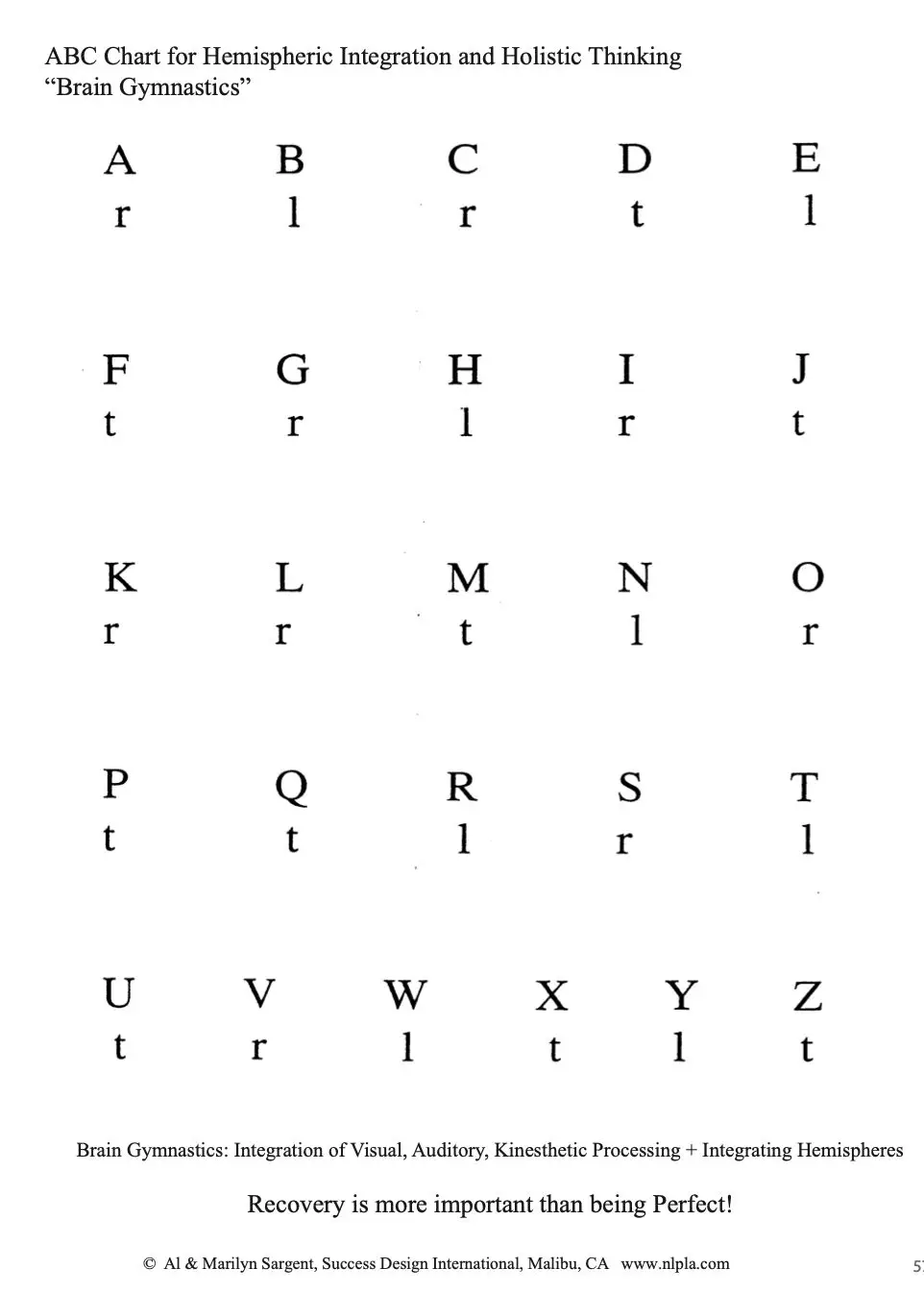
As a coach, it is good to give your clients tangible tools and skill building drills for them to practice and use in particular situations. The ABC chart is one of these tools that will enhance the processing functions in the brain overall. It will help train the client to focus in the moment and have balanced processing.
Skill Building Drill: Brain Gymnastics
ABC Chart for Hemispheric Integration and Holistic Thinking
“Brain Gymnastics”
Purpose: To enhance information processing, bring balance and focus when facing a challenge, improve memory, integrate full brain activity, increase clarity and calm the system.
Instructions for using the Chart:
Take your time and move through the exercise with calm breathing, a good sense of humor, and if there is a “mistake or glitch” just keep going.
Remember: “Recovery is more important than being Perfect !”
Part A: Integration of Visual, Auditory and Kinesthetic Processing
Simultaneously…
Visual : See the Capital Letter of Alphabet Auditory: Say the Capital Letter of Alphabet Kinesthetic: Move the corresponding hand(s) to match the lower case letter underneath the Capital Letter.
Example: Line 1 of the chart
Simultaneously: See the A, say it out loud, bend the right elbow and bring up the right hand and then back down to relaxed position.
See the B, say it out loud, bring up the left hand, bending at the elbow and back down.
C is the same as A. See the D, say it out loud, bring up two hands together and back down. E is the same at B.
Part B: Crossing Hemispheric Dominance
(Once Part A is familiar and comfortable, add in this level of difficulty)
As you see, say and move the corresponding hand, now at the same time, lift the opposite knee to the hand that is raised. When there is the lower case t (moving both hands together) do a slight double knee bend or, if you feeling are ambitious, give a small spring up into the air.
In life, particularly in a learning situation, it works best to acknowledge progress and let go of internal criticism or judgment.
The usefulness of this exercise is to get all systems working simultaneously, to increase concentration, and wake up the brain. Doing this before a task requiring focus, memory, challenge or stress will give the optimum chance for clear and resourceful thinking. It also creates new neural pathways in the brain for on-going success.
Relax and Have Fun!
Scientific Memory Strategy
Read and review the Chapter on Memory Skills in The Other Mind’s Eye: The Gateway to the Hidden Treasures of Your Mind, pages 95 to 115. This will give you more of an understanding of the foundation of natural memory strategies. Even though we use the metaphor of spelling as a teaching example, this is the same strategy for remembering anything that we want to be able to store in our mind and then be able to retrieve the information by choice.
Hemispheric Integration Memory Strategy
Purpose: To access left and right hemispheres of the brain to install information, and to recall for memory.
Establish rapport and ecology for working together. Calibrate Explorer for their natural visual memory accessing.
Optional: Explain and demonstrate Explorer’s current external dominant eye. This step shows that there is a difference in eye dominance and will assist in determining the internal dominant eye for Hemispheric Integration Memory Strategy.
Have Explorer choose a word (noun) that is easy to spell and that they already know. We will use the example “cat.” This step is to learn the process and to create success.
Have the Explorer create a visual image of a cat using their left mind’s eye, and put this image in their visual recall field; usually located slightly up and to the Explorer’s left with visual accessing.
Say to Explorer, “Now allow that visual representation of a cat to remain here (gesture to hold the image in the visual recall field) as you shift to your right mind’s eye, and in a way that works for you, build in the letters ‘c-a-t.’ Now you are seeing the word ‘cat’ connected to the picture of what a cat looks like.”
Next, have the Explorer choose a word they would like to be able to spell.
Build a visual representation of what the word means, using the left mind’s eye. Build the letters for the word with the right mind’s eye. (Remember to chunk into small pieces, if needed).
Repeat Steps 5 & 6 using an image of a person with their telephone number in the image.
Test the Explorer’s memory of the easy word; the word they chose; and the person with their telephone number.
Discuss with the Explorer when and where this process will be useful in their life to remember important facts, names and information.
Strategies for Processing: Motivation, Deciding, Being Convinced
In the sequence of strategies for navigating life there first is an awareness of a desire or goal or a want or need. This is the cue or trigger to take action; the beginning of manifesting what we want and stopping or eliminating what we don’t want.
We begin by being motivated to reach a goal. A healthy motivation strategy will also have a “beyond self” component that motivates us to stay with the process to get the benefit or result of the effort put into a series of steps over time to reach a desired goal.
Along the way we need a good decision making strategy for making effective choices and protecting ourselves. Being clear on criteria is essential and being flexible to be able to adjust as new information is added, while staying in alliance with the goal.
Next we need to develop an internal knowingness or convincer strategy that at a certain point, we have done or learned enough for now. It is important to know when we are complete either with the entire goal or certain measurable accomplishments along the way. This loops back to having a well-designed blueprint for the goal so that we know when the goal matches in current reality as complete.
Motivation Strategy:
Structure of an effective motivation strategy:
• The benefit or outcome the client is wanting must be more important and more compelling than the struggle or work needed to achieve the goal.
Example:
The client wants to exercise and needs to be
at the gym four days per week to reach their desired weight/strength goal.
Discover: What is the benefit through exercising that the client wants to experience? i.e. Fitting into the bathing suit for the cruise; being able to dance and play when they are lighter and stronger; lowering their cholesterol so they can be here for their grand kids and live a long and healthy life.
• Understanding what is wanted and what is not wanted, both Present State to Desired State.
• Focus on the benefits or end result desired – not on the process or steps to get there!
Motivation Direction:
People are motivated into action by moving away from a danger or threat that is not wanted or creates fear, or going towards a future goal that is compelling enough to set them into action. The two ends of the thinking continuum are:
Moving Towards what is wanted: Compelled/pulled into action. Proactive, directive, decisive, courageous.
Moving Away from what is not wanted: Pushed into action. Reactive, fearful, hesitant, limited, unfulfilled.
In healthy motivation thinking, the person will incorporate both moving away from what is not wanted and toward having what they do want. Being aware of both directions, both the dangers and the benefits, generating a strategic action plan to get results, and focusing on taking action in moving forward toward the goal is the sequence that brings success.
The Best Motivation Strategies:
- Are Short
- Focus on the positive consequences or benefits of taking the necessary steps of toward accomplishing the required tasks.
- The internal voice has a pleasant, compelling and encouraging tonality.
- The internal voice uses words of desire, possibility, confidence, “I can.”
- The task is chunked-down appropriately into manageable size pieces.
- Along the pathway to success, the comparing how far the person has come and the progress being made toward the future.
Typical Problems with Motivation Strategies for Coaching Clients:
1. Client begins with being in overwhelm already.
Solution: Clarify the goal(s), create aplan and set a reasonable time frame.
Chunk it down.
2. Client has only a “negative” perspective about what is not wanted, moving away from pain.
Solution: Add a representation of the possible positive results and the pathway to get them.
3. Client uses language patterns that keep them stuck, either too much drama or negative energy. Uses limiting beliefs that are overgeneralizations of truth. Deletes details. Distorts the facts.
Solution: Shift to language of possibility and specificity. Adjust voice tone and language structure to create a win-win interaction.
4. Procrastination: Usually is a result of being incongruent about the goal(s); ambivalent or fearful.
Solution: Resolve the confusion about the goal with the Anchors Away process. Continue to look for solution. Flexibility. Tenacity.
5. Client is incongruent about the results wanted or believes is possible.
Solution: Ask the client, “What image comes up when you think about the goal? Gather information from each mind’s eye with a statement about the goal. See if there are any other objections internally.
Here is more information about best practices to motivate your client.
Decision Strategy:
When making a decision, first the goal must be clearly specified. The details of criteria, standards and/or requirements that govern the intensity of interest in any given context are crucial in defining the goal. As a Spencer Institute Certified Life Strategies Coach, your job is to help discover and guide your client in developing these important points of boundary and focus.
Learning Opportunity: Criteria Elicitation
Find a partner to practice with. Establish rapport.
1. Simultaneously, each of you write three lists. Answer the question, “What’s important for you about a vacation?” “…about a job?” and “…about a friend?”
2. Exchange lists with your partner. Take each criteria word listed and ask your partner, “And, why is that (insert criteria word) important?” Followed by, “And, what is important about having that (insert criteria word #2)?” Use your Approachable Voice and a state of friendly curiosity. This will give you a person’s highly valued criteria in each of the contexts. Notice if the same criteria words show up in more than one category. Each additional “And, why is that important?” is designed to take the person deeper into their value system and up the levels of the Hemispheric Integration Template. Do this for Partner A & B.
3. Person A pick a category from Person B’s list, for instance, “Vacation” and try to convince Person B about a going on a vacation using any criteria words opposite of the ones on their list. Notice their verbal and non- verbal response. Have Person B notice their response also.
4. Repeat step #3. This time weaving Person B’s exact criteria words into your proposal and notice their response.
This exercise is designed to gather the sorting filters that a person uses to make decisions, be motivated and be open to saying ‘yes’ to a proposal or suggestion. Begin to notice in everyday conversations what criteria words are being used by a friend or colleague. When being a life coach, the ability to find the client’s highly valued criteria is critically important in guiding your client to reach the life changes desired.
Example:
Step #1 Person A’s Vacation List: Fun, Adventure, with a Special Person, Exploring, Spontaneous.
Step #2 Exchange Lists. Person B asks A: “And, why is exploring important?” Person A responds, “I love the excitement of discovering something new?”
Person B asks A: “And what is important about the excitement of discovering something new?” Person A responds, “I love learning. It makes me feel so free to be me!”
Step #3 Person B (using A’s list and using any criteria words except what ones on A’s list) “So, if we were to go on vacation, I have a great idea, let’s sign up for a tour group that is tried and true. They are really organized and they have a firm schedule for seeing the main sights of the regions we will pass through.” Calibrate Person A’s non-verbal and verbal response.
Shake that off. – “Break State.”
Step #4 Person B (using the criteria words on A’s list) “Or, another great idea I had for a vacation was for just you and me to get in the car and head north in the general direction of Mt. Shasta. We have a whole week for a fun adventure to explore any parts of the area we feel like. There is a huge array of choices from mountains to ocean, and we are free to decide what we feel like doing each day. (implied spontaneous). Calibrate Person A’s response.
Reverse roles.
Learning Opportunity: Criteria
Become more and more aware of the criteria words that a client uses. These words are meaningful to them and need to be honored as you work together. It is a good way to build respect and give the client the feeling of being heard. When Pacing and Leading these words become important “Anchors” for the client’s experience.
Decision Strategy Elicitation:
Each of us has a strategy or sequence of filters through which we make decisions, no matter in what the context, we have our preferred system of modality representations. As a coach it is important to identify the decision strategy sequence of your client. It will help you in guiding your client in making decisions and, if needed, to modify the strategy to get better results.
In the manual, you will see the chart of the Brain in Hemispheric Integration Concepts and Technology section. Notice that each side of the brain has a VAK. What that means for making decisions is that one side of the brain may have a sequence that is Visual – I see the option (for instance when buying a new car), Auditory – I hear the facts and details of the price and so on, and Kinesthetic – I get in and drive it and it’s great = Buy it.
The other hemisphere may have a different sequence such as Kinesthetic – Let me drive it first, then if it feels good, Auditory – we can talk about the details and price, then Visual – and color or looks are not that important as long as it’s clean. = Buy it.
When being an effective CLSC using the Hemispheric Integration techniques, we can keep our clients from getting caught in a loop, or being taken advantage of by guiding them to access both sides of the brain when making a decision.
Learning Opportunity: Strategy Elicitation
Ask the Explorer to think of a situation where they made a decision and they are happy with the results. Typically something easy like, “Where did you buy that pair of shoes?” or “…watch?” or “…decide to join your gym?”
Then have them associate (step back) into that experience as if they were there then.
CLSC asks, “What did you do first when you bought your shoes?”
Client: “Well I had been wanting some new shoes for walking, and I was shopping in the mall the other day and saw (Visual) a pair I liked in the window of the store.”
CLSC: (backtrack step 1) “So you had been wanting some walking shoes and when you were shopping you saw a pair of shoes that looked good (verifying the visual) to you in the window of the store, right?” Client: Head nod – “Yah.”
CLSC: Then what did you do next?”
Client: Well, I went into the store and talked (Auditory) to the clerk to make sure they had my size and color and to find out how much they cost.” (Details/information: Criteria words.)
CLSC: (backtrack step 2) So you talked with the clerk to find out the price and make sure they had what you wanted?”
Client: “Yes.”
CLSC: “What did you do next?”
Client: “Hmm,…since they had my size and it was in my price range, I decided to try them on to be sure they were comfortable (Kinesthetic) and looked good (Visual) on my feet.
CLSC: Since you are wearing those shoes today, we know you bought them, right?
Client: Head nod – “yah.” (chuckle)
CLSC: How did you decide that this was the pair of walking shoes that would be good for you?”
Client: “Well, actually, I tried on two other styles of shoe, and these were the ones that looked good, were in my price range, and fit the best. So I bought them.” (Convincer Strategy: Internal authority, three options in order to know.”
CLSC: “And are you happy with these shoes and your decision?”
Client: “Yes.”
CLSC: Now we know that your strategy for buying shoes is a VAK sequence – that works for you. Would you have bought them without trying on other styles?”
Client: “No, I needed to know that I had made the best choice.”
CLSC: (Backtrack full sequence): So for you to make a decision that you are satisfied with you first need to see the options, then talk about the details, facts and price, then try it on, get a feel for it, somehow experience two other options, then when one option all matches – you make your choice and are satisfied that you have made a good choice for you. How does that feel emotionally (asking for Meta-K evaluation)? Client: “Good.”
Criteria Words for this exchange:
V – Look good, color
A – Talk about my price range, size, details
K – Comfortable
Then the CLSC can discuss whatever current issue is keeping the client stuck and not making a decision. Make sure all three components (VAK) are being addressed in sequence and that the client needs to have two other comparisons to make to be convinced they are making the right choice.
Learning Opportunity:
Another way that a client can keep themselves stuck is in not directly comparing the choices or options that could all be beneficial in moving toward the goal. Or, the client fails to gather the criteria for the goal and checking out the benefits and drawbacks of each of the choices.
Example: Client: “Part of me wants to go to the gym to work out early in the morning, and part of wants to go to my friend’s boot camp at 6:00am to work out.”
Presuppositions: The person has decided to work out early in the morning. There are two acceptable options to choose between.
Option A: Gym Option B: Boot camp
Elicit Criteria words for each option: “What’s important about…?”
List the Pros and Cons of each side:
Pros Cons
Now hold these options side by side. And one side or the other will ‘pop out’ as the obvious choice. If not, then the CLSC knows there is a deeper issue or hidden saboteur to be addressed with other Hemispheric Integration techniques.
The sequence of making a decision is:
1. Be clear on the goal.
2. Gather information
3. Evaluate the information. Compare and Contrast to what is wanted or not wanted.
4. Decide amongst the options and make a plan.
5. Implement the Plan: States and Strategies for Action.
If you only have one choice – you are stuck.
If you have only two choices – you have a dilemma. When you have three choices – the brain will become generative and more creative.
Once you have several choices there is more clarity to decide what will work best for the results wanted.
Convincer Strategy: “How do I know…?”
This is the process of being sure or convinced when you have done enough for now. It answers the question, “How do you know you know?” For your client, it’s important to know, “who is the perceived authority for them?” And “how will they know when X is done enough?” We are looking for the exit strategy or “this is complete” or “I am satisfied that this is enough for now.” with a full VAK congruent response.
Knowing that I know is such a good feeling and supports my confidence. Text box
Authority: Who makes the decisions, who is in control?
Internal control: Power from the inside of the person sending out into the world.
Proactive – Confident.
“I gather information, evaluate it, and then I decide what action to take.”
External control: Power and control come from the outside world over the person.
Reactive – Victim.
“What do you think I should do? I’ll wait and see what happens. What will they think about me if…?”
When helping someone take responsibility for changing, growing or learning, sometimes the first thing a coach needs to do is guide the client toward is getting becoming their own authority or boss. Otherwise, if the client is constantly seeking approval, permission or agreement they will never know within themselves for sure and that will sabotage progress. See the Video for further a discussion about how to become more Proactive.
The second part of the convincer strategy is finding out how many replications of success the client has to experience to be sure they can be successful. For most people the first time they experience something it is awkward, the second time builds confidence, and by the third time they are enjoying the success. So for this person, three replications of success and they are convinced.
Another strategy filter is about how long it takes before they know, or not know.
Length of time: “Once I do it for three weeks, I know I will be comfortable.”
Automatic: “I just know. I can tell right away.” (often this is the internal control person.) (Proactive: Internal authority)
Consistent: “I have to re-check.” Or “Well, maybe over time…” This person is constantly re-evaluating and are rarely convinced for sure because there always is a counter-example or doubt. (Reactive: usually external authority)
Once you can elicit a person’s convincer strategy, you will be able to influence them in a proactive way. If you elicit a strategy that is a “junker” then you guide the person to update limiting beliefs or perspectives, so that they can create a more healthy and useful convincer strategy.
What to work on first
As the coach, it is your job to gather information about the issue, help define the specific focus, goal, or intent and then to segment the problem into a step-by-step plan to create change. Whatever the issue, it requires you to be a good detective, to search for the underlying patterns or limiting beliefs that need to be released, then teaching and installing new skills and capabilities, powerful beliefs that support the client’s values, and other strategies and patterns for effectiveness.
As a personal life coach, your main job is to assist your client in being able to clearly acknowledge the current problem or challenge and find out where this challenge pattern occurred first in the client’s life circumstance. Then engage the client to define what is wanted – the desired state of being and experience, when that problem no longer exists.
If your client brings you a list of what they want (or don’t want): listen, takes notes, ask them which is the most important piece to take care of first. Or, if you sense an eminent re-occurrence of an unresourceful state – this is where the help must begin.
ready to earn your professional credentials?
Go here >>> https://spencerinstitute.com/certification-programs/life-strategies-coach-certification/