Meta-Model: The Language of Specificity
Becoming an expert communicator requires precise information gathering and linguistic skills. Learning distinctions of language and how to create clarity will prevent, or at least lesson, the slippage of meaning that occurs with assumptions and over-generalizations.
Having knowledge of the Meta-Model language skills in this chapter, combined with the awareness of non-verbal communication learned in earlier chapters, will give you the awareness to be a good pattern detector and to more effectively get your point across. Another benefit is that when others are being vague, you will be able to ask just enough questions to bring specificity to the conversation or written document.
We have created some acronyms to help in the memorization and organization of these tools and to give you a road map to understand where we are going. We begin with the concept of Bridging the GAP. When we are meeting a challenge for ourselves, or facilitating others to find solutions, it works best to first identify the Present State or challenge situation. Once current reality has been established, then it is important to clarify the details of the Desired State, criteria and future scenario to give direction and focus. This enables a more direct route to resolution and helps give measurable feedback along the journey to the goal.
The Meta-Model is a set of linguistic distinctions and inquiries that allow you to gather information when the meaning in a communication is unclear, and to be able to make a proposal or send a message in more precise detail.
Language is the surface structure about what’s going on in your brain. Words are just representations that stimulate the brain to form images and sounds in order to create meaning in a conversational exchange. According to a study done in Great Britain, the conscious mind can only handle seven bits of information, plus or minus two, in any given moment, while the unconscious mind is processing about 200,000,000 bits of data. So as to not get consciously overwhelmed, our brain deletes, distorts and generalizes external stimuli as we are exposed to it. We guide our conscious mind as to what to pay attention to and where to focus, depending on our intentions, priorities, safety and personal history. Since any language is limited by descriptive definitions and the meaning each brain makes of words, depending on our particular filters, establishing a common understanding when communicating is an art. The intention of the Meta-Model is to fill in the blanks and make communication more of a flow of information.
There are seven basic words in English that are useful in gathering additional information: Who – What – Which – When – Where – How – Why. The meta-model identifies which questions will elicit the most useful information available depending on whether the desired information has been deleted, distorted, or generalized.
The best way to retrieve information and the structure of thinking is by asking how, what, when, which, where, and with whom. Questions that begin with ‘why’ move to the Belief and Value Level on the Hemispheric Chart, and will usually cause the person to defend their position, their decision, or their actions. Although questions that begin with ‘why’ are useful to get a person to state a belief, ‘why’ questions are not likely to elicit the specific sensory-based information associated with the Meta-Model Inquiries.
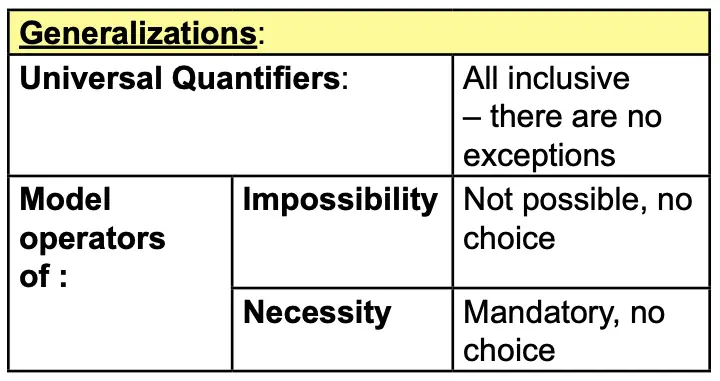
Within the three basic categories of the meta-model (delete – distort – generalize), there are 10 basic language patterns that are most useful.


Softeners: The meta-model questions can easily become obnoxious, particularly if you use a quick, harsh, angry tonality. The question could be perceived as being sarcastic. The meta-model questions can be softened with phrases such as:
“I’ m curious, which person were you specifically referring to?”
“I’m wondering, …?”
“Just to make sure I understand can you give me an example of how…?”
Any addition to a meta-model inquiry that will help remove the perception of a personal attack or direct challenge to the information given can be used as a softener. As with all communication techniques, context, purpose, and the level of permission will determine the necessity and extent of the usage of softeners. Remember, tonality has a major effect on whether the inquiry will be perceived as seeking information or if the inquiry is intended as sarcasm.
Getting Started
This article was written by Al Sargent and Marilyn Sargent of Success Design International. They are the authors of the Spencer Institute’s Life Strategies Coach Certification and the Results Coach Certification.
If you found this article helpful, you will want to click over it and get more information on how to use this in a coaching setting. For more information on Al and Marilyn, visit www.repoweryourlife.com