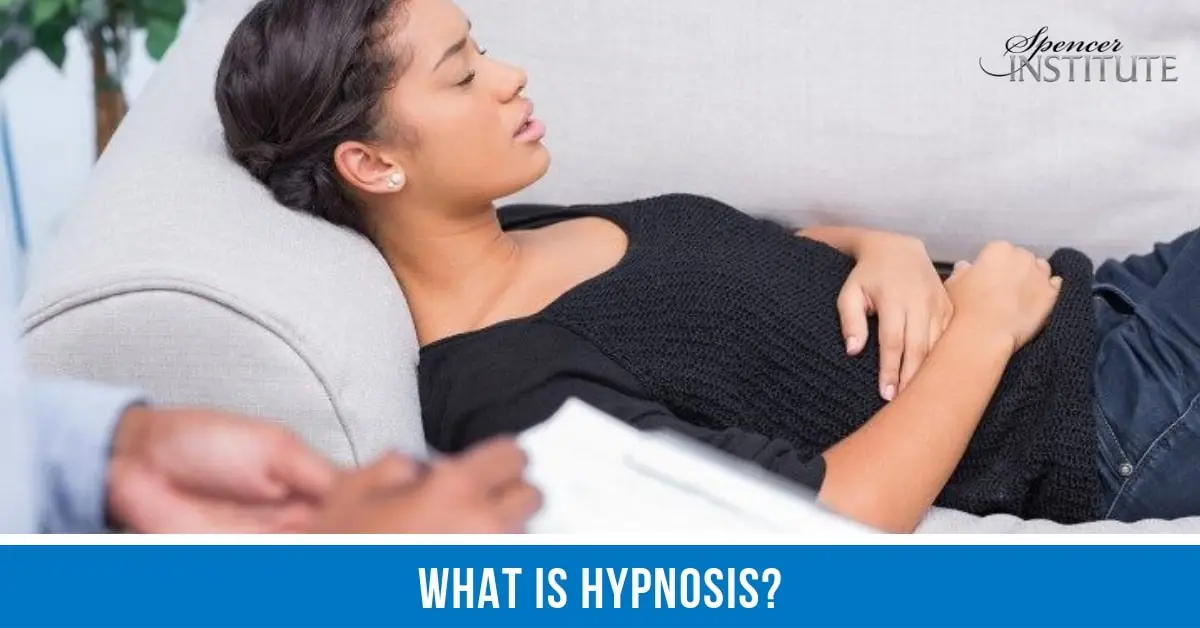
 Hypnosis IS…
Hypnosis — or hypnotherapy — uses guided relaxation, intense concentration, and focused attention to achieve a heightened state of awareness that is sometimes called a trance. The person’s attention is so focused while in this state that anything going on around the person is temporarily blocked out or ignored. In this naturally occurring state, a person may focus his or her attention — with the help of a trained therapist — on specific thoughts or tasks.
1. An awake state
Hypnosis requires the active participation of both conscious and unconscious processes. So you must remain awake in order for it to be considered hypnosis. Yes, it is possible to fall asleep during hypnosis, but then it becomes sleep and stops being hypnosis.
During hypnosis, the conscious mind, and the unconscious mind are still present. The only thing that is missing is the critical faculty. The term, critical faculty has many different names depending upon what school of psychology you come from. It’s been referred to as the analytical filter, the subjective reality filter, critical mind, and so on. It doesn’t matter what term you use, but it’s important to understand its function. The critical faculty has been incorrectly defined by many as the part of you that distinguishes between reality and fantasy. This is not true, for if it was, that would mean during hypnosis you would not be able to distinguish between reality and fantasy. This, of course, is not what happens. By modifying the traditional definition slightly, it makes much more sense. It’s the part of you that cares to distinguish between reality and fantasy.
During hypnosis, you know what is real and what is not, but you don’t care to define any difference. It’s exactly like watching a movie or reading a novel. You realize that what you are watching or reading isn’t real, but you don’t care to acknowledge that while you are being entertained. As a result, your body goes through many different biochemical changes as if it were really experiencing the event in the movie or in the book.
2. A state of relaxation
The critical faculty fades away in direct proportion to the level of relaxation the body and mind are experiencing. The deeper into relaxation you go, the further removed the critical faculty is. However, this does not mean you need to be in a deep state of hypnosis in order to accept the suggestions. In fact, there is, to my knowledge, no study to substantiate depth of trance equating to the success of a hypnotic process. The only exception to this would be in the case of pain control, where it is generally accepted that the client should be in a deep state of hypnosis before any medical procedures have begun. Knowing this, there have been case studies where people have successfully controlled pain in light states of hypnosis as well. The depth of trance for anesthesia is simply a precaution more than a requirement.
3. All about following instructions
Many people believe that hypnosis has to do with intelligence, but in reality, it has everything to do with following instructions. If the hypnotist uses language which is beyond the intellect of the client, they most likely will not be hypnotized. They can’t, they don’t understand the instructions. However, this is not the client’s fault. This is the hypnotherapist lack of sensitivity to the client’s low intellect. This is a reflection of a poor hypnotist, not an unintelligent client. The hypnotist needs to organize their language to match that of the intellect of the client. For highly educated clients, use complex language, for uneducated people, use simple language. It will work much better.
4. The ultimate display of control
When people say they cannot be hypnotized because they are a self-proclaimed “control freak” they are mistaken. In fact, when someone claims this you need to inform them that as a control freak if they cannot reach the deepest states of hypnosis immediately, then as a control freak, they are very bad at control. Here’s why: if you are in total control of your body, you would be able to be as tense, or as relaxed as you want to be. To say you can’t relax because you are a control freak indicates you don’t have the control to relax your muscles. This makes no sense. The more in control you are of your mind and body, the more you should be able to reach both extremes of tension and relaxation.
Now if hypnosis isn’t about going deaf, and losing control, what is it, and why does it work so well. The reason hypnosis works so well is that the body responds to commands from the mind, much like a robot responds to commands from the programmer. You are in charge, you tell your body what to do.
Here’s a great example, when you read a book, do you generate emotions inside your body? What is an emotion? An emotion is a biochemical change. Now, would you ever say for a moment that the words on the page created the biochemical changes in your body? No. What did? It was your interpretation of the words. You interpreted the words in such a way that it created a thought. That thought became so realistic your body created a biochemical shift inside your body as if you were actually in the storyline.
Now would you ever read a book like this, “This isn’t happening, this is stupid, I’m not there right now, they aren’t real, and this isn’t really going on.” No, of course not, that would be crazy. But you know what? I have people come to my office, and I’m amazed that some people sit there and under hypnosis do that exact thing. They sit there and say, “This isn’t really happening, I’m not floating on a cloud, there’s no relaxing waterfall in this room, this isn’t really going on at all.” Can you imagine? These people are wasting their time and money, not very bright, is it? Look, I know there are no waterfalls in this room, I know you aren’t’ really floating on a cloud, I just want you to imagine you are like when you let your imagination run free while reading a book.
Here, let me give you an example. Close your eyes, I want you to imagine that you are in your house, and you walk into the kitchen. Perhaps you can imagine the feeling of the floor against your feet. As you walk to the refrigerator, I want you to imagine reaching your hand out, grabbing the handle and giving the door a slight tug. You can feel the magnets holding the seal at first, but soon you hear that all too familiar sound of a refrigerator door opening. Perhaps you could just imagine the feeling of the cool air greeting your skin. And of course the little light comes on, and inside I want you to just pretend that there is a bowl of fresh ripe juicy lemons inside. As you pretend to pick up one of those lemons with your hand, you can imagine the feeling of the cool rind resting in the palm of your hand.
Now, I want you to imagine going over to the countertop and taking your favorite paring knife. Just imagine slicing the lemon into four evenly sliced wedges. Perhaps you can pretend to hear the sound of the lemon tearing as the knife cuts its way through the fibers of the lemon. Juices squirt out on the countertop, and as you pick up one of the lemon wedges between your thumb and forefinger, just pretend that there is juice dripping down onto the palm of your hand. You can imagine seeing the seeds hiding in between the fibers of the lemon.
And now, I want you to imagine placing the lemon wedge in your mouth, and as you bite down your teeth separate the fruit from the rind and you begin chewing that tangy, bitter lemon in your mouth… Now, open your eyes. Notice the amount of saliva in your mouth (while nodding), it increased, didn’t it? Now was there really a lemon there? No, but the robot thought so didn’t it? Now, I know it’s just spit, but it is a chemical. It’s just a chemical that we can produce instantly without having to take a blood test to measure, but the same thing can be done with blood pressure, hormone levels, and any other biochemical process.
Remember – The purpose of the lemon exercise is to prove to your client that the body responds like a robot, and whatever the mind sees, the body tends to do. Hypnosis works so well because it creates thoughts in the mind that are so realistic, the body reacts biochemically.
Now What?
First, take some time to learn more about the benefits of self-hypnosis.
Then, learn more about becoming a Certified Sports Psychology Coach. Sport psychology is the scientific study of people and their behaviors in sports and the practical application of that knowledge. Sports Psychology Coaches have endless opportunities to work with athletes ranging from beginning to professional and all points in between. Some coaches build businesses working with youth athletes. Others specialize in sports such as triathlon. Other coaches work with teams in the college and pro ranks. There are no limits to what is possible for your career.
Spencer Institute coaching programs are open to anyone with a desire to learn and help others. There are no prerequisites.
That’s it for now.
Take action!
PS: Click here to see many helpful business/career resources