Components of Creating Precise and Purposeful Anchors

Anchors are the triggers or cues that create the meaning and/or response we give to circumstances and events. An anchor can be established in any of the modalities. Our purpose in this course for studying this phenomenon is to:
- Identify an anchor and the response being elicited by it.
- Learn how to release the knee-jerk response a limiting or outdated anchor can elicit.
- Learn how to establish anchors for a proactive and positive response in ourselves and in others.
What are Anchors?
An anchor can elicit either a resourceful response that is appropriate for the situation, or it can elicit an unresourceful response, often out of the person’s awareness or control and at the extreme becomes a phobic reaction.
Anchors are the super glue that stick experiences together – behavioral habits and routines, sleep postures, that special “our song,” smells, even words are just anchors for certain ways of thinking based on our history and experiences.
It is important to be aware of keeping positive anchors “clean.” For instance, let’s say it’s important that the bedroom be a place for peace and safety. Arguing over bills or bringing work into the bedroom can contaminate this comfort.
When bringing up a negative issue with someone or giving bad news, be sure your face does not get connected to the problem, stand or sit to the side and gesture to the piece of paper or spatial location that represents the issue.
With our clients, it is important to be aware of negative “hooks” or anchors that trigger negative behaviors or responses. With the processes of Hemispheric Integration these hooks can be permanently changed to a more resourceful response or feeling.
Another way for a coach to use this valuable tool is in installing new anchors to help the client develop new habits and behaviors in response to a stimuli.
Components of Creating an Anchor
-
Purity of state accessed
-
Intensity of state accessed
-
Timing of anchor
-
Uniqueness of anchor
-
Accuracy of duplication
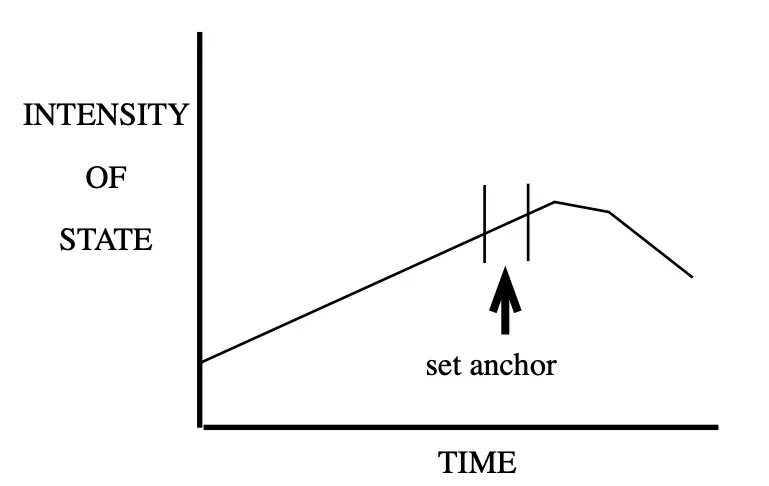
The anchoring diagram shows the relationship between timing and intensity when creating an anchor. The components that create a solid anchor are the intensity of the state accessed, the purity of the state, timing of setting the anchor to catch the peak of the state, and the uniqueness of the experience.
As a coach, we are creating anchors all of the time and being precise and purposeful in this is important. The words, gestures, facial expressions, set up of the office, voice tone and so on become familiar i.e., anchors for experience.
Throughout the course, there are several techniques that are specifically designed to unhook old unresourceful anchors and tools for creating new responses to an old stimuli.
Chaining anchors is a technique used to connect one state of being to a certain context. Stacking anchors refers to adding more than one state of being onto the original state. Integrating anchors takes one experience or response and integrates it (combines it) with another, thereby creating a third resourceful anchor that is a mixture of both.
Circle of Excellence and Creating States of Excellence
Purpose: To access and stabilize states of excellence. To have these states automatically available in previously challenging situations that may occur in the future.
This tool is useful to chain a positive resource state to a situation where more resources are needed. This is good for situations where more confidence is needed, humor, or more patience for example. It is important that the resource state is more powerful or intense than the state that was previously associated with the situation.
Guide Says to Explorer:
Context of challenge. “Think of a situation where you would like to have more resources. Set that aside for a moment, we’ll come back to it when you have more resources.”
1. Setting up the Circle of Excellence: “Imagine a circle on the floor in front of you. What does it look like? What color is it, what material is it made of? Are there any sounds in the circle?”
2. Have client think about an excellent state that is a resource for them. “What state of excellence would you like to have more of in your life? Think of a state where you have resources available to you that allows you to act in ways that will support you and protect you.”
3. Anchoring (stabilizing) state of excellence to circle: “Think of a time when you were in this state in a way that was fully satisfying to you. Pretend you are there now, re-experiencing those feelings, images and sounds. When you feel how that feels fully, step into your circle.” Give gentle guidance with a hand on the shoulder and motion to the client to step into the imagined circle on the floor. Give explorer time to feel the purity of the state. Amp it up if you want to. “Now, step back out of the circle, leaving that state of excellence there.”
4. Separator State: Distract with any question that will elicit a neutral state such as, “What is your phone number backward? How was lunch?”
5. Testing: “Step back into the circle, and notice how that feels now.” Calibrate for a return of the state of excellence physiology you saw in step 3. “Now step back out of the circle.” Create a separator state again.
Please Note: If the response is not as strong as desired, elicit another example that gives a stronger response, repeat step 3, 4, & 5. You may also stack or add other resources at this point. When the response anchor is fully evident, then go to step 6.
6. Chaining Anchors: “In a moment I am going to touch your shoulder. When I do, I want you to immediately step forward into that circle, into that excellent state. First, I want you to think again about that time or situation where you would like to have more of this particular state of excellence.” As soon as client begins to access the unresourceful state, gently nudge their shoulder as a signal to step forward into the circle. Observe to be sure client accesses the new state of excellence.
7. Testing: Ask client to step back out of the circle (separator state). “Where or when in the future might that situation occur again?” or “What happens when you think of what used to go wrong?” Observe to be sure that client only briefly accesses the unresourceful state and then automatically accesses the state of excellence. If the state needs strengthening – step into the circle again or continue to stack more resources into the circle of excellence (a spatial anchor).
8. Future Pace: Have the client creatively think of a way to carry their circle with them so that it will automatically be available in many other situations as needed in their future. Watch for the non-verbal cues for congruency.
Note: Once there is an understanding of the structure of the process, it can also be done with yourself.
Getting Started
This article was written by Al Sargent and Marilyn Sargent of Success Design International. They are the authors of the Spencer Institute’s Life Strategies Coach Certification and the Results Coach Certification.
If you found this article helpful, you will want to click over it and get more information on how to use this in a coaching setting. For more information on Al and Marilyn, visit www.repoweryourlife.com