

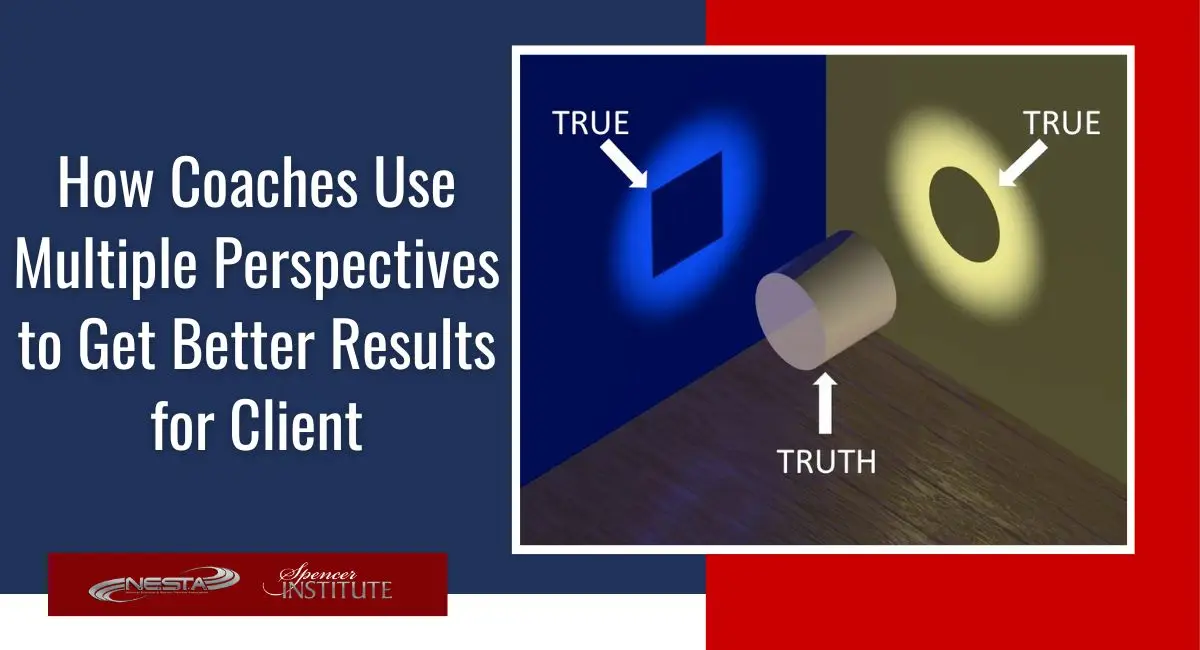
 As a Certified Life Strategies Coach or in any leadership position, the first step in creating change or making progress is precise and detailed information gathering. Getting the full picture of where your client is now and where they want to be creates a blueprint system that can be followed to build success.
All too often, a coach is tempted to immediately start fixing or giving advice when they hear about a challenge. This is a limiting trap and leads to an incomplete structure. And remember, in the Hemispheric Levels Template for living life – each level has to be considered for solid change work to happen – from a solid foundation to the joy of the finishing touches.
Reminder: All change work can be divided into two main categories:
1. The client has a particular goal. There is nothing apparently stopping them and yet they are not reaching their goal. Or, there is a missing link between the current skills of the client and what skills are needed to be fully successful. In these cases the coach looks for the roadblocks or hidden saboteurs, and builds new skills and expertise.
2. The client is currently experiencing or participating in an activity, thought or behavior that they no longer want to be involved with – and yet they continue to make choices that lead to the unwanted experience. The client will often say they “feel” like they cannot stop the old behavior.
Defining the Goal or Desired Result for Your Coaching Client
This part of the process is often overlooked when a coach gets bogged down in problem solving or “fixing.” Nature doesn’t allow a vacuum, so before we help a client remove a problem or change a behavior or response, it is crucial that the client has already created and prepared what he or she is wanting instead. This will make doing change work ecologically sound.
Ecology in the context of coaching means evaluating and considering the impact of the proposed change on the larger system. When ecology is considered, the coach can then proceed with the technical work with a much better foundation of understanding. We want to have any change last through time, as the client develops and practices new behaviors and responses.
Define the Current Challenge or Problem for Your Client
When a client describes their individual challenge, listen to how they describe their “stuckness.” The structure of their language will give you many clues as to what is causing them to not move forward to get the results they say they want. Remember the list of Presuppositions in the first section of this manual? One says that, “People already have all of the resources they need.” And, “People always make the best choice available to them at the time.” The job of a coach is to make more options available to the client so that they are able to make new and more appropriate choices. And “Choice is better than no Choice.”
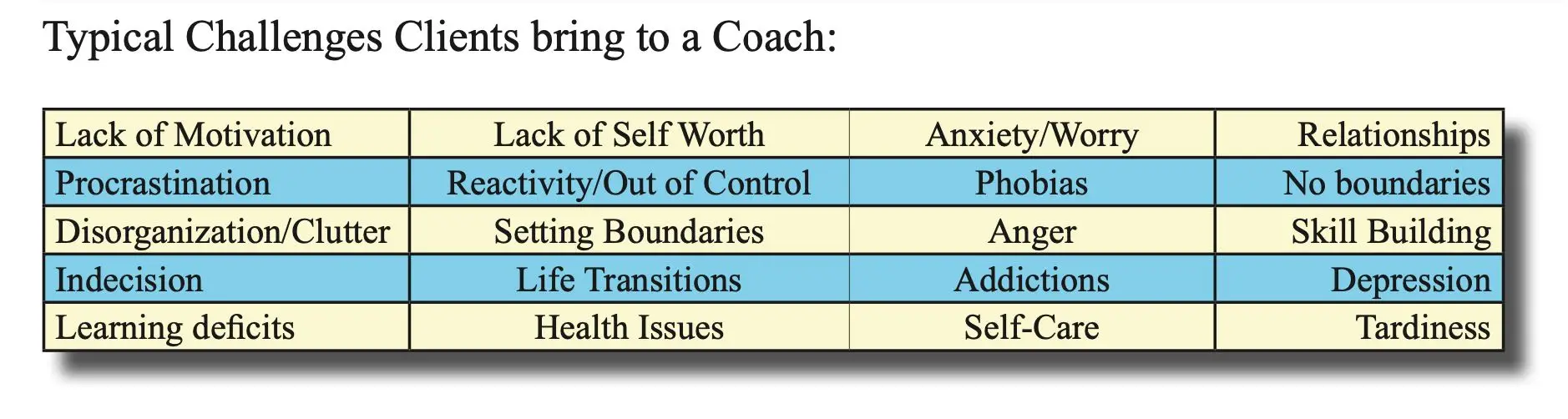
Whatever the issue, as a coach your job is to be curious, to search for the underlying patterns or limiting beliefs that are holding your client back, then installing new skills, powerful beliefs that support the client’s values, and patterns or strategies for results effectiveness and a solid sense of personal identity. Then the client can look beyond everyday challenges to have choice in defining their individual passion or mission and who or what is beyond self: where they want to connect and have a sense of spirit.
For instance: If someone were to get in a cab and the driver asks, “Where do you want to go?” An “away from” response is “I don’t want to go downtown. And I don’t want to go the Zoo. And I don’t want to just sit here.” The driver still has no clue as to where to take the passenger. Stuck! (Or the driver gets to choose and takes the client to where the driver wants togo–which most likely, is not where the passenger wants to end up!)
Example of a Common “Away from” Challenge: Procrastination
Presenting issue or behavior the client wants to stop, presented as if it were the goal.
Client: “I want to stop procrastinating.”
Find out how procrastination manifests for this particular client:
• Not getting paper work done in a timely fashion.
• Putting things off to the last minute, creating stress and sub-standard results.
Possible Underlying Causes:
- Conflicting goals or No goal at all
- Benefits or Goal not clearly defined
- Ineffective motivation or time management strategy
- Inability to set appropriate boundaries
- Overwhelm. Task seems: “…larger than life.” “…never-ending.” “If I finish, they will just pile more on.” “…impossible for me” “I’m not good enough or I don’t deserve to have….” “Success could require me to do X behavior that is a perceived danger or overwhelming responsibility.”Moving Toward Results andPleasure: “When you stop procrastinating, what will you be doing differently?”
Get tangible, behavioral evidence of what the client will see, hear and do (VAK) when they are successful in getting the results they really want. Sometimes this concept of asking for what they want is so unfamiliar for the client, asking them to “pretend as if…” makes it easier to begin to imagine a positive future.The Power of Perspective: Being a Good Detective
Scientists say that fish can’t see the water because they are swimming in it – and this is often true for humans as well. We cannot see the solution to a challenge because we are too involved in only one perspective (our own) of a situation, and this is another situation where a effective coach can be so valuable.
The Certified Life Strategies Coach brings multiple perspectives, facts, and options to the coaching/client relationship:
- Active listening.
- A detective looking for the structure of how a client is thinking, processing and behaving.
- Observing and identifying patterns previously out of the client’s conscious awareness.
- Respect, curiosity, expertise, wisdom, with a willingness to ask questions for clarity.One of the many benefits of learning the Hemispheric Integration work is to know that when we guide our clients to their chosen results, along the way, they will develop new “thinking” or neural connection/perspective.
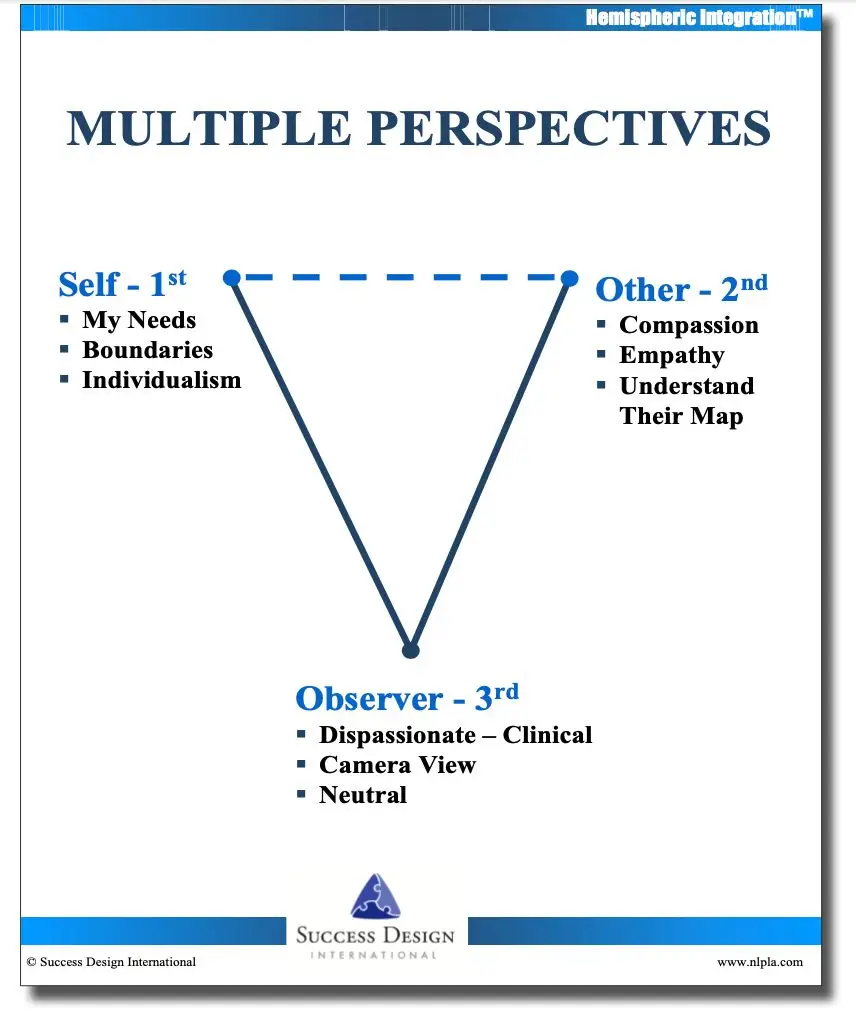
As you see in the chart, there are three main perspectives we can benefit by focusing through for any given situation:Feedforward – “Dress rehearse” or imagine the new behavior or thought patterns for future success in similar situations. What are the lessons learned from this experience that can be applied toward the future to bring better results? What new choices will work even better in the future to move closer to the results that are wanted?
Often expectations are based on assumptions, hope, and imagination and are not based in reality. Typically, a challenge or frustration occurs when something happens that does not meet a client’s expectations – and without a clear blueprint, expectations are often not based in reality or fact and we are led down a path that sabotages success and disappoints.
As a coach, your job is to create a learning cycle for the client through your suggestions and recognition of ineffective patterns. When you watch the video (in the certification course) of the Hemispheric Integration demonstrations, notice how Al and Marilyn use softeners to align with the client and be respectful such as: “I’m curious…,” “I was wondering…,” “What I offer is…,” “What would happen if…?,” “So that I can be clear, what I heard you say is…(backtracking)….”
A key to the success of Feedback-Feedforward is first having clarity about the goal to be achieved. Then, when evaluating what happened, understandings are based on facts, evidence, and what’s likely or possible. There is no place here for blaming, avoiding, fault-finding, name calling, or judgment. While it may feel good to vent (rant), take a breath or two, focus on the goal and then give feedback to self or others, coming from a caring and neutral position.
Developing the Blueprint System and Plan of Action
First, it is essential to develop a clear understanding and agreement of the goal or result the client desires. An excellent tool for doing this is a set of eight questions called a Well-Formed Outcome, or Get Clear Form. This is similar to an architect who begins with studying the “lay of the land,” and gathering information about the environment he has to work with. When you are coaching, use the eight questions as a template to help complete a detailed roadmap of current reality, which then can lead to generating success.
Once the Well-Formed Outcome information is gathered, then you will be able to establish the modules for change, and the content and structure of the coaching sessions that will lead to your client’s success. You and your client will discover what the limiters or road-blocks are currently, which then become the focus for creating change. This specific Plan of Action also needs to have built in accountability for the client with tasks or homework to bring the new skills and behaviors into a level of desired competency. Then the client can begin to set the Plan of Action in motion, leading to steady and solid accomplishment and growth.
Structure of Language Patterns: Precise Information Gathering
Because our conscious mind has a limited capacity to process and share, we take short cuts in order to make sense of the world. We delete, distort, and generalize information constantly. In casual conversation this is acceptable because there is no particular goal or agenda. However, when wanting to help someone to move from where they are to where they want to be – it is important to have all of the information necessary to do a thorough job.
This is where active listening is so important. As your client is sending you information, be sure you are creating internal images of what they describe. If there are details missing or gaps that don’t make sense, this information has to be filled in and clarified.
Learning Opportunity: Eight Well-formed Outcome
Questions/Information Gathering Using the basic template and Hemispheric Integration Techniques Demonstration (refer to the Video Presentation) document the following:
Elicit three Well-formed Outcomes for yourself and goals you have in the following
Contexts:
Work and careerRelationships Long-term life goals
Do the process with a minimum of 10 other people so that this becomes a familiar, automatic way of thinking for you as a coach. Knowing what to ask and where to proactively influence gives you a strong foundation to work with your client.
We naturally view things from our “Self” perspective, with our way of thinking and feeling based on our history.
It is useful to step out to an “Observer” position. Let go of any agenda or need and just view the interaction from this neutral, fact-finding perspective. The “Observer” part of us can send information back to “Self” with a broader scope of the scene, and we can expand awareness of the situation.
“Other” position represents a person we are in interaction with, or a group of people. From neutral “Observer” position, step into the position of “Other” and try the experience on from their viewpoint. Make your best guess as to what their experience may be and how “Self” looks through this person’s eyes. From this perspective, you are just information gathering, curious. For “Other” to be behaving the way they are, what must be their filters? Now step back to “Observer” perspective and then back to “Self” position. “Self” now has three perspectives, rather than just one; generating wider options of choice for how “Self” wants to act.
The goal with this information gathering tool is to have multi-perspectives of any situation. This gives better understanding and more options to negotiate for win-win results.
The Backbone of Coaching: Feedback – Feed forward
The best teacher is experience and evidence, without getting sidetracked by judgment or negativity.
Feedback – Evaluate what happened: Did that previous action get you or your client closer to the goal? If not, what part of the action did not work? What part of the action did work to move toward achieving the goal? What would you do differently if this situation were to occur again? What have you learned? How do you need to set boundaries for your own personal safety in the future.

